
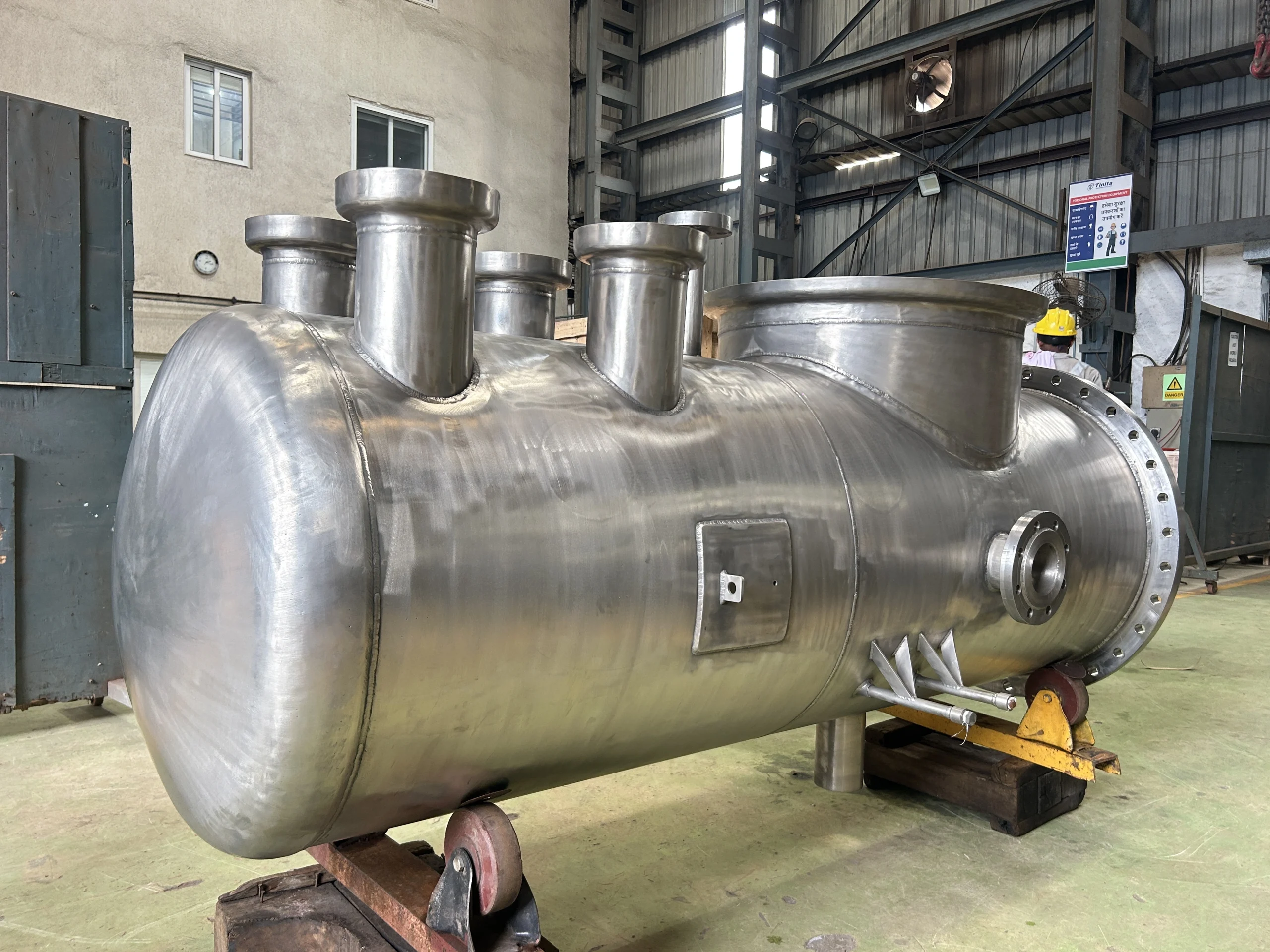
Pressure-containing equipment has to perform reliably under demanding operating conditions. Whether a vessel is handling gases, liquids, corrosive chemicals, hydrogen or process mixtures, its design and fabrication need to be developed around the actual service conditions.
Pressure vessels are engineered equipment used to contain fluids at pressures that may be significantly above or below atmospheric pressure. They are widely used across oil & gas, petrochemical, chemical, fertilizer, pharmaceutical, pulp & paper and power & energy applications.
At Tinita Engineering Pvt. Ltd., pressure vessels are designed and fabricated for specific process requirements, with a strong focus on corrosion-resistant materials, mechanical integrity, fabrication quality and applicable design codes.
Tinita’s pressure vessel range includes Vapour Liquid Separator Vessels, Discharged Air Vessels, Suction Air Vessels, Hydrogen Buffer Vessels and Dopp Kettle Vessels, along with customized pressure-containing equipment. The company also works with Titanium, Tantalum, Zirconium, Hastelloy and Duplex Stainless Steel for demanding applications.
What Is a Pressure Vessel?
A pressure vessel is a specially designed container intended to safely contain gases or liquids under a specified internal or external pressure.
Unlike a conventional storage tank operating near atmospheric pressure, a pressure-containing vessel must be engineered to withstand the mechanical stresses created by its design pressure, temperature and service conditions.
Depending on the application, a vessel may operate under:
- Internal pressure
- External pressure or vacuum
- Elevated temperature
- Low-temperature service
- Cyclic pressure conditions
- Corrosive chemical environments
- Hydrogen or other specialized process services
This makes pressure vessel design a multidisciplinary engineering activity involving mechanical design, metallurgy, welding, inspection and quality assurance.
Why Pressure Vessel Design Matters
The vessel shell is only one part of the engineering requirement.
A reliable pressure vessel needs to account for:
- Design pressure
- Operating pressure
- Design temperature
- Operating temperature
- Vacuum conditions where applicable
- Material of construction
- Corrosion allowance
- Shell and head thickness
- Nozzle loads
- Support arrangement
- Internal components
- Thermal conditions
- Fatigue or cyclic loading where applicable
- Applicable design codes
- Inspection and testing requirements
The final design should therefore be based on actual process data rather than selecting a vessel only by size or nominal capacity.
For pressure-containing equipment designed to applicable ASME requirements, ASME Section VIII provides rules for the construction of pressure vessels.
Types of Pressure Vessels Manufactured by Tinita
Tinita Engineering’s current pressure vessel portfolio includes several specialized designs developed for different process requirements.
Vapour Liquid Separator Vessel
A vapour liquid separator vessel is designed to separate vapour and liquid phases from a process stream.
The separation requirement depends on the process conditions, flow characteristics and required separation efficiency.
Tinita manufactures both vertical and horizontal vapour liquid separator vessels. Vertical configurations can be suitable for applications with higher gas-to-liquid ratios, while horizontal configurations can be advantageous where larger liquid volumes need to be handled.
For projects requiring a dedicated separator, explore Tinita’s Vapour Liquid Separator Vessel page.
Discharged Air Vessel
A discharged air vessel is used in pumping and industrial systems to help stabilize pressure and fluid flow.
These vessels can be important in applications where pressure fluctuations, pulsation or surges need to be managed to support reliable pump operation.
Tinita’s discharge air vessel solutions are used in applications including drilling and mud circulation systems, offshore and onshore rigs, petrochemical plants and high-pressure pumping stations.
Read more about the Discharged Air Vessel manufactured by Tinita Engineering.
Suction Air Vessel
A suction air vessel is installed on the suction side of a pumping system to help maintain consistent inlet conditions.
By supporting smoother inlet pressure and flow, the vessel can help reduce the risk of unstable pump operation and improve overall system reliability.
Tinita supplies customized suction air vessels for drilling and mud circulation systems, offshore and onshore rigs, petrochemical plants and high-pressure pumping stations.
Explore the Suction Air Vessel product page for more details.
Hydrogen Buffer Vessel
Hydrogen systems require carefully engineered equipment for handling and controlling hydrogen flow.
A hydrogen buffer vessel can act as a stabilizing volume between hydrogen generation and downstream compression or process equipment. Tinita describes its hydrogen buffer vessels as equipment used between electrolysis and compression to help manage output fluctuations and provide a more regulated hydrogen flow.
These vessels can be customized in terms of size, capacity, flange connections, configuration and instrumentation according to project requirements.
For hydro
gen applications, see Tinita’s Hydrogen Buffer Vessel solution.
Dopp Kettle Vessel
A Dopp Kettle Vessel with a limpet coil is designed for process applications involving controlled heating or cooling.
The vessel configuration can be customized according to the required process conditions and application. Tinita currently lists a pressure rating of up to 175 bar for its Dopp Kettle Vessel offering, subject to project-specific design requirements.
Typical industries include:
- Chemical processing
- Petrochemical processing
- Pharmaceutical manufacturing
- Oil & gas
- Fertilizers
- Pulp & paper
Learn more about the Dopp Kettle Vessel with limpet coil.
Pressure Vessel Materials: Why Material Selection Matters
Material selection is one of the most important parts of pressure vessel engineering.
The correct material depends on much more than pressure and temperature. Engineers must also consider:
- Chemical composition
- Concentration
- Corrosion mechanism
- Chloride exposure
- Hydrogen exposure
- Operating temperature
- Mechanical loads
- Weldability
- Fabrication requirements
- Required service life
- Inspection requirements
For demanding process environments, conventional carbon steel or stainless steel may not always provide the required corrosion performance.
This is where specialized metallurgy becomes important.
Titanium Pressure Vessels
Titanium is widely considered for pressure vessel applications where strong corrosion resistance is required in aggressive process environments.
Tinita manufactures Titanium Pressure Vessels for applications across chemical, petrochemical, pharmaceutical, oil & gas, fertilizer, pulp & paper and power sectors. Its available configurations include solid-wall construction, explosive-clad construction, jackets, half-pipe jackets, baffles, dip tubes and spargers.
Titanium can be particularly valuable when localized corrosion, cracking or long-term corrosion performance is a major design concern.
Explore the dedicated Titanium Pressure Vessel page.
Tantalum Pressure Vessels
Tantalum is selected for particularly demanding corrosive environments where exceptional corrosion resistance is required.
Tinita manufactures tantalum pressure vessels for applications across chemical, petrochemical, fertilizer, oil & gas, pulp & paper and power industries. The vessels can be manufactured using solid-wall or clad configurations, with features such as jackets, baffles, dip tubes and spargers depending on the project.
For severe chemical services, the material selection should always be based on the actual chemical composition, concentration and temperature.
Explore Tinita’s Tantalum Pressure Vessel solutions.
Zirconium Pressure Vessels
Zirconium offers excellent corrosion resistance in selected aggressive chemical environments and is used for specialized process equipment.
Tinita’s zirconium pressure vessel designs include large-diameter configurations, explosive-clad construction, standard jackets, half-pipe jackets, agitators, drives, baffles, outlet valves and dip tubes.
Applications include chemical, petrochemical, pharmaceutical, fertilizer, pulp & paper and oil & gas processes.
For projects requiring zirconium construction, see the Zirconium Pressure Vessel page.
Hastelloy Pressure Vessels
Hastelloy is a family of nickel-based alloys used in demanding environments where corrosion resistance is a primary consideration.
Depending on the service, different Hastelloy grades can provide different combinations of corrosion resistance, temperature capability and mechanical performance.
Tinita’s Hastelloy pressure vessel range includes grades such as:
- Hastelloy B-3
- Hastelloy C-22
- Hastelloy C-22HS
- Hastelloy C-276
- Hastelloy C-2000
- Hastelloy C-4
- Hastelloy G-30
- Hastelloy G-35
- Hastelloy N
Available vessel configurations include solid-wall construction, explosive-clad construction, standard jackets and half-pipe jackets, along with process components such as baffles, dip tubes and spargers.
See Tinita’s Hastelloy Pressure Vessel capabilities.
Duplex Stainless Steel Pressure Vessels
Duplex stainless steel combines useful mechanical strength with corrosion resistance and can be considered for demanding chemical, petrochemical and oil & gas applications.
Tinita manufactures Duplex Stainless Steel Pressure Vessels in configurations including solid wall, explosive clad, standard jacket and half-pipe jacket designs. Additional components can include baffles, agitators, drives, dip tubes and spargers depending on the process requirement.
For corrosion-sensitive process applications, see the Duplex Stainless Steel Pressure Vessel page.
Solid, Clad and Jacketed Pressure Vessel Construction
Pressure vessels do not always need to be manufactured entirely from one material.
Depending on the application, Tinita can work with:
Solid Wall Construction
The complete pressure boundary is manufactured from the selected material.
This approach can be appropriate where the process conditions require the same material throughout the pressure-containing structure.
Explosive Clad Construction
Clad construction combines a structural base material with a corrosion-resistant alloy layer.
This approach can reduce the amount of expensive exotic alloy required while maintaining a corrosion-resistant process-contact surface.
Tinita’s clad pressure vessel capabilities include Titanium, Zirconium, Tantalum, Hastelloy, Nickel alloys, Inconel, Monel and Duplex Stainless Steel cladding options.
Explore Tinita’s dedicated Clad / Explosion Clad Pressure Vessels page.
Jacketed and Half-Pipe Jacket Construction
Some process vessels require heating or cooling during operation.
Standard jackets and half-pipe jackets can be incorporated into the vessel design according to process requirements, heat-transfer requirements and mechanical design conditions.
This type of construction is particularly relevant to vessels used for controlled process heating or cooling.
Pressure Vessel Design Considerations
A pressure vessel manufacturer must evaluate the complete equipment specification before fabrication.
Design Pressure
Design pressure establishes the pressure boundary that the vessel must safely withstand under the specified design conditions.
It should not simply be based on normal operating pressure. The design basis must consider applicable operating scenarios and project requirements.
Design Temperature
Temperature affects material strength, allowable stress, corrosion behaviour and fabrication requirements.
The design temperature should therefore be established along with the pressure conditions.
Shell and Head Design
The shell, heads and other pressure-retaining components must be designed according to the applicable code and project requirements.
Head geometry, thickness, forming method and joint configuration can all affect the final equipment design.
Nozzles and Openings
Nozzles are often among the most highly engineered areas of a vessel.
Their design must consider:
- Process connections
- Reinforcement
- Piping loads
- Instrumentation
- Flange requirements
- Orientation
- Accessibility
- Inspection requirements
Supports
Depending on the vessel arrangement, supports can include:
- Skirt supports
- Saddle supports
- Leg supports
- Lug supports
- Custom structural arrangements
The support system must account for vessel weight, operating conditions, wind or seismic loads where applicable, transportation and installation requirements.
Pressure Vessel Fabrication Process
A pressure vessel fabrication project normally involves several controlled stages.
1. Engineering and Design Review
The project begins with review of:
- Process datasheet
- Design conditions
- P&ID
- General arrangement drawings
- Material specification
- Applicable code
- Inspection and test plan
- Client specifications
2. Material Procurement and Traceability
Pressure-containing materials must be procured according to the approved specification.
Material certificates, heat numbers and traceability are important throughout fabrication, particularly when exotic alloys or clad materials are involved.
3. Plate Preparation and Forming
Depending on the vessel design, plates may undergo cutting, edge preparation, rolling and dish-end forming.
Tinita’s broader fabrication infrastructure includes shell rolling and dish-end forming capabilities for large process equipment.
4. Welding
Welding procedures must be selected according to the material, thickness, joint configuration and applicable code.
Exotic materials such as Titanium, Hastelloy and other nickel alloys require appropriate welding controls to maintain material integrity.
5. Heat Treatment
Where required by the material specification, thickness, code or project specification, heat treatment and stress relieving may form part of the fabrication process.
6. Inspection and Non-Destructive Examination
Inspection may include:
- Visual examination
- Dimensional inspection
- Radiographic testing
- Ultrasonic testing
- Dye penetrant testing
- Positive Material Identification
- Hydrostatic testing
- Pneumatic testing where applicable
- Leak testing where specified
Tinita’s current pressure vessel page identifies capabilities including 100% radiography, PMI, heat treatment, stress relieving, hydro testing up to 500 bar and pneumatic testing up to 30 bar.
Codes, Standards and Compliance
The applicable code depends on the vessel design, service, destination market and project specification.
For applicable pressure vessels, ASME Section VIII is a key construction code used for pressure-vessel design and fabrication. Engineers and manufacturers should refer to the applicable requirements of the ASME Boiler and Pressure Vessel Code when establishing the design and fabrication basis for pressure-containing equipment.
Tinita’s current pressure vessel portfolio lists ASME, IBR, U, U2 & R Stamp certifications and PED among its standards and certifications.
For equipment intended for applicable European markets, the European Pressure Equipment Directive (PED) 2014/68/EU should also be evaluated according to the equipment’s design conditions, category and applicable conformity-assessment requirements.
For European-market projects, the applicable PED requirements should therefore be established during the engineering stage rather than assumed for every vessel.
Pressure Vessel Applications
Pressure vessels are used across a wide range of industries.
Oil & Gas
Applications can include separation equipment, air vessels, process vessels and other pressure-containing equipment used in upstream, midstream and refinery operations.
Petrochemical
Petrochemical plants require vessels capable of handling process fluids under controlled pressure and temperature conditions.
Material selection can become particularly important where corrosive chemicals or elevated temperatures are involved.
Chemical and Specialty Chemical
Chemical processing frequently requires pressure vessels fabricated from corrosion-resistant materials such as Titanium, Tantalum, Zirconium, Hastelloy and Duplex Stainless Steel.
Fertilizer
Fertilizer plants can expose equipment to aggressive chemicals and demanding process conditions, making metallurgy and fabrication quality important considerations.
Pharmaceutical
Pharmaceutical applications can require carefully controlled materials, surface condition, fabrication procedures and documentation depending on the service.
Pulp & Paper
Pulp and paper processes can involve corrosive chemicals and elevated operating temperatures, requiring appropriate material selection and equipment design.
Power & Energy
Pressure vessels are used in a range of power and energy applications where controlled containment and reliable operation are essential.
Tinita currently identifies oil & gas, petrochemical, fertilizer, chemical, pulp & paper and power & energy among the industries served by its process equipment portfolio.
How to Choose a Pressure Vessel Manufacturer
Choosing a pressure vessel manufacturer should go beyond comparing quotations.
For an engineering-intensive project, evaluate:
Material Expertise
Can the manufacturer fabricate the required material correctly?
This is especially important for Titanium, Tantalum, Zirconium, Hastelloy and Duplex materials.
Engineering Capability
Can the manufacturer understand the process data, design conditions, code requirements and project specifications?
Fabrication Capacity
Does the facility have the equipment and infrastructure required for the vessel diameter, length, thickness and weight?
Welding Capability
Does the manufacturer have qualified welding procedures and experience with the selected metallurgy?
Inspection Capability
Can the manufacturer provide the required NDE, testing, traceability and documentation?
Code and Certification Experience
Does the manufacturer have experience with applicable ASME, IBR, PED or other project requirements?
Customization
Can the vessel be customized for nozzles, supports, jackets, internals, agitators, dip tubes, spargers and other project-specific requirements?
These factors are often more important than simply selecting the lowest initial quotation.
Why Choose Tinita Engineering for Pressure Vessels?
Tinita Engineering Pvt. Ltd. combines process-equipment engineering with specialized fabrication expertise in exotic and corrosion-resistant materials.
The company currently manufactures pressure vessels with capabilities extending up to approximately 5,200 mm diameter, 40 m internal length and 89 tons, subject to project-specific design and fabrication requirements.
Key capabilities include:
- Customized pressure vessel fabrication
- Titanium pressure vessels
- Tantalum pressure vessels
- Zirconium pressure vessels
- Hastelloy pressure vessels
- Duplex Stainless Steel pressure vessels
- Solid-wall construction
- Explosive-clad construction
- Jacketed and half-pipe jacketed vessels
- Vapour-liquid separators
- Air vessels
- Hydrogen buffer vessels
- Dopp Kettle Vessels
- Large and specialized process equipment
- Radiographic testing and PMI
- Hydrostatic and pneumatic testing where applicable
Tinita’s broader manufacturing portfolio also includes heat exchangers, reactors, columns, storage tanks and piping spools, allowing projects to be supported by a wider static process equipment manufacturing capability.
Frequently Asked Questions About Pressure Vessels
What is a pressure vessel?
A pressure vessel is an engineered container designed to safely contain gases or liquids under specified internal or external pressure conditions.
What materials are used for pressure vessels?
Depending on the process requirements, pressure vessels can be manufactured from carbon steel, stainless steel, Titanium, Tantalum, Zirconium, Hastelloy, Nickel alloys, Duplex Stainless Steel and other suitable materials.
What is the difference between a pressure vessel and a storage tank?
A pressure vessel is designed for specified pressure conditions, which may be above or below atmospheric pressure. Storage tanks are generally designed for atmospheric or relatively low-pressure storage, depending on their application and code requirements.
What is a Vapour Liquid Separator Vessel?
A Vapour Liquid Separator Vessel is designed to separate vapour and liquid phases from a process stream. It may be supplied in vertical or horizontal configurations depending on the process requirements.
What is a Hydrogen Buffer Vessel?
A Hydrogen Buffer Vessel provides an intermediate volume for stabilizing hydrogen flow between process stages such as electrolysis and compression.
Why are Titanium pressure vessels used?
Titanium can be selected where high corrosion resistance is required for a particular process service. The grade and construction should always be evaluated against the actual chemistry and operating conditions.
Why use a clad pressure vessel?
Clad construction can combine the structural characteristics of a base metal with the corrosion resistance of a bonded alloy layer, potentially reducing the amount of expensive exotic alloy required.
What information is needed to manufacture a pressure vessel?
A manufacturer generally requires the process datasheet, design pressure, design temperature, operating conditions, capacity, material specification, P&ID, general arrangement requirements, nozzle details, applicable codes and project inspection requirements.
Final Thoughts
A pressure vessel is a critical part of many industrial process systems, and its reliability depends on the complete engineering and fabrication process.
The right combination of design, metallurgy, welding, inspection, testing and quality control is essential when equipment is exposed to pressure, temperature or corrosive process conditions.
For demanding applications, specialized materials such as Titanium, Tantalum, Zirconium, Hastelloy and Duplex Stainless Steel can provide solutions where conventional materials may not be suitable.
Tinita Engineering Pvt. Ltd. manufactures customized pressure vessels and specialized process equipment for chemical, petrochemical, oil & gas, fertilizer, pharmaceutical, pulp & paper and power & energy applications.
If you are evaluating a new pressure vessel or replacing existing equipment, provide the process conditions, design pressure and temperature, material requirements, drawings and applicable project specifications to Tinita’s engineering team for a suitable fabrication solution.



 English