
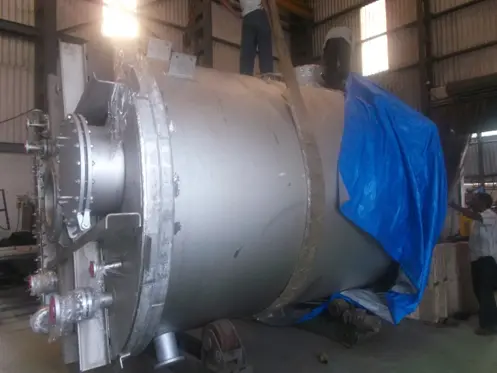
Industrial processes that handle chemicals, corrosive vapours, acid fumes or toxic gases require more than standard storage equipment. The tank material, fabrication method, corrosion resistance and overall design must match the actual process conditions.
Scrubber tanks are used in industrial environments where gases, fumes, particulates and chemical vapours need to be collected, neutralized or handled safely as part of a process or pollution-control system.
For industries such as chemicals, petrochemicals, oil & gas, fertilizers, pulp & paper and power, selecting the right material and fabrication approach can have a direct impact on equipment life, maintenance requirements and plant reliability.
Tinita Engineering Pvt. Ltd. manufactures customized scrubber tanks and other storage tanks using corrosion-resistant and high-performance materials selected according to the process requirements. Its storage tank manufacturing capabilities extend up to 5,200 mm diameter, 40 m inner length and 89 tons in weight.
What Is a Scrubber Tank?
A scrubber tank is an industrial tank designed for applications associated with the collection, handling or treatment of contaminated process streams, chemical fumes and gases.
Depending on the process arrangement, the tank may form part of a gas-cleaning or chemical-handling system where contaminants are brought into contact with a suitable liquid or treatment medium.
The exact configuration depends on factors such as:
- Process fluid and chemical composition
- Operating temperature
- Pressure or vacuum conditions
- Corrosion characteristics
- Liquid level and volume
- Gas flow and contaminant loading
- Required residence time
- Material of construction
- Design codes and project specifications
There is therefore no single scrubber tank design that fits every application. A properly engineered tank starts with understanding the process conditions and selecting the construction materials accordingly.
How Does a Scrubber Tank Work?
The working principle of a scrubber system varies according to the process and the type of contaminant being treated.
In a typical wet scrubbing arrangement, a contaminated gas or vapour stream comes into contact with a liquid medium. The liquid can capture, absorb or chemically react with selected contaminants. The resulting liquid and treated gas are then directed through the appropriate downstream process.
The tank may serve different functions depending on the plant design, including:
- Holding the scrubbing liquid
- Supporting circulation of the treatment medium
- Collecting contaminated liquid
- Providing process residence volume
- Handling chemical reaction products
- Supporting gas-liquid contact equipment
- Collecting solids or particulates where applicable
For this reason, scrubber tank design should be developed around the complete process rather than treating the tank as a simple storage vessel.
Scrubber Tank Design Considerations
Good equipment performance begins with the design stage. Before fabrication starts, the manufacturer needs to understand the process conditions and mechanical requirements.
1. Process Conditions
The first consideration is the actual service.
The engineering team should evaluate:
- Fluid or chemical composition
- Concentration
- Operating temperature
- Design temperature
- Operating pressure or vacuum
- Specific gravity
- Corrosivity
- Liquid level
- Flow conditions
- Cleaning requirements
Even a small change in chemical concentration or temperature can influence material selection and corrosion performance.
2. Material of Construction
Material selection is one of the most important decisions when fabricating scrubber tanks.
Depending on the service, suitable materials may include:
- Titanium
- Tantalum
- Zirconium
- Nickel and nickel alloys
- Hastelloy
- Inconel
- Monel
- Duplex stainless steel
- Super Duplex stainless steel
- Other stainless steels or clad constructions where applicable
Tinita Engineering has specific expertise in reactive metals, nickel alloys, Hastelloy, Duplex and Super Duplex materials for demanding process applications. Its broader storage tank range is designed around customized material selection based on application and client specifications.
The correct material should be selected based on the complete service environment rather than simply choosing the most corrosion-resistant material available.
3. Corrosion Resistance
Scrubbing applications can involve aggressive chemicals, acidic or alkaline solutions and contaminated process streams.
Corrosion can occur through several mechanisms, including:
- General corrosion
- Pitting
- Crevice corrosion
- Erosion-corrosion
- Stress corrosion cracking
- Localized attack
Material compatibility should therefore be reviewed against the actual process chemistry, temperature, concentration and operating conditions.
For highly corrosive services, reactive metals or nickel alloys may provide a more suitable solution than conventional carbon steel or stainless steel.
4. Tank Geometry and Dimensions
Tank geometry affects fabrication, operation, inspection and maintenance.
Depending on the application, the design may include:
- Vertical or horizontal configuration
- Cylindrical shell
- Dished or formed heads
- Nozzles and manways
- Internal supports
- External supports
- Lifting arrangements
- Platforms and ladders
- Drain connections
- Overflow arrangements
- Instrument connections
The final dimensions should be established from the required working volume, operating conditions, available space and transportation limitations.
Tinita’s current storage tank manufacturing capabilities include diameters up to 5,200 mm, inner lengths up to 40 metres and equipment weights up to 89 tons, subject to project-specific requirements.
Materials Used for Scrubber Tanks
Material selection becomes particularly important when the scrubber system handles corrosive gases or liquids.
Titanium Scrubber Tanks
Titanium can be considered for applications requiring high corrosion resistance combined with relatively low density compared with many conventional corrosion-resistant alloys.
It is particularly relevant to chemical and process environments where corrosion performance is a major design consideration.
Nickel Alloy and Hastelloy Scrubber Tanks
Nickel alloys and Hastelloy grades can be selected for demanding chemical services where resistance to aggressive media and elevated temperatures is required.
The exact alloy should always be selected based on the process chemistry and design conditions.
Duplex and Super Duplex Scrubber Tanks
Duplex and Super Duplex stainless steels combine high strength with strong resistance to several forms of corrosion. They can be useful where both mechanical strength and corrosion performance are important.
Clad Construction
For some large process equipment applications, clad construction can provide a practical combination of structural strength and corrosion resistance.
A carbon-steel structural layer can be combined with a corrosion-resistant alloy through an appropriate cladding technology. Tinita works with solid, loose-lined and clad constructions, including explosion bonding, roll cladding and weld overlay.
Similar material-selection considerations also apply to specialized chemical-service equipment such as peroxide tanks, where corrosion resistance and compatibility with the process medium are important.
The appropriate construction depends on process requirements, design conditions, fabrication considerations and project specifications.
Scrubber Tanks vs. Pre-Scrubber Tanks
Although the terms are closely related, a pre-scrubber tank and a scrubber tank can have different roles within a process system.
A pre-scrubber system is generally positioned upstream to remove larger particles, acid mist or selected contaminants before the process stream reaches the main scrubbing stage.
This can help reduce the contaminant load entering the main scrubber and support more effective downstream operation.
Tinita’s pre-scrubber tank offering is specifically described for applications involving the removal of solid particles, acid mists and harmful gases before they enter the main scrubber system.
For projects requiring both stages, the design of the pre-scrubber and main scrubber should be considered together.
Industrial Applications of Scrubber Tanks
Scrubber tanks are relevant across industries where chemical vapours, fumes and contaminated process streams must be managed effectively.
Typical industries include:
Chemical Industry
Chemical plants may handle acids, alkalis, solvents and other aggressive chemicals. Corrosion-resistant tank construction can be important for maintaining reliability.
Petrochemical Industry
Petrochemical processes can generate hydrocarbon vapours, acid gases and other contaminants that require controlled handling and treatment.
Oil & Gas Refineries
Refineries use various gas and vapour treatment systems to manage process emissions and corrosive streams.
Fertilizer Industry
Fertilizer plants often operate with corrosive chemicals and gases, making material selection an important part of equipment engineering.
Pulp & Paper Industry
Chemical recovery and bleaching-related processes can expose equipment to corrosive chemicals and fumes.
Power & Energy
Power plants and energy facilities may require specialized systems for handling gases, chemical solutions and process emissions.
Tinita Engineering currently identifies oil & gas, petrochemicals, fertilizers, chemicals, pulp & paper and power & energy among the industries served by its scrubber tank solutions.
Fabrication Considerations for Scrubber Tanks
Fabricating a scrubber tank from corrosion-resistant or exotic materials requires more than simply forming and welding the shell.
Important fabrication considerations include:
Welding Procedure
The welding procedure must be compatible with the selected material and thickness.
For reactive metals and nickel alloys, proper control of welding parameters, cleanliness, shielding and contamination is particularly important.
Dimensional Control
Large tanks require careful control of:
- Shell roundness
- Straightness
- Nozzle orientation
- Head alignment
- Flange positioning
- Support locations
- Overall dimensions
Dimensional accuracy becomes especially important when the tank must integrate with existing piping, platforms or process equipment.
Surface Condition
The internal surface may be critical where the tank handles corrosive chemicals or high-purity process fluids.
Surface preparation, cleaning and finishing requirements should therefore be established according to the process specification.
Inspection and Testing
Inspection requirements depend on the design, material, service and applicable project specifications.
Depending on the project, quality control may include:
- Dimensional inspection
- Visual inspection
- Weld inspection
- Non-destructive examination
- Material identification and traceability
- Hydrostatic or other applicable testing
- Leak testing where specified
- Documentation review
For pressure-containing equipment, the applicable construction code and jurisdictional requirements should be established during the engineering stage. Where applicable, equipment intended for the European market may also need to be assessed against the European Pressure Equipment Directive (PED) 2014/68/EU, depending on its design conditions and scope. The PED covers the design, manufacture and conformity assessment of pressure equipment and assemblies with a maximum allowable pressure greater than 0.5 bar. ASME BPVC Section VIII, for example, provides requirements for applicable pressure vessels covering design, fabrication, inspection, testing and certification.
Why Material Selection Matters in Corrosive Services
A tank may look structurally sound during commissioning but still experience premature failure if the material is not compatible with the process chemistry.
A proper material selection study should consider:
Chemical compatibility + concentration + temperature + pressure + contamination + mechanical requirements + expected service life
This is why experienced process equipment manufacturers look beyond the nominal material grade.
For example, a material that performs well in one acid concentration may behave differently at another concentration or temperature. Similarly, chloride contamination can influence the corrosion behaviour of certain stainless steels.
The objective should therefore be to select a material that provides the required combination of:
- Corrosion resistance
- Mechanical strength
- Fabricability
- Weldability
- Temperature capability
- Expected service life
- Overall project economics
Scrubber Tank Accessories and Connections
A scrubber tank is normally integrated into a wider process system. Depending on the application, the equipment may require customized accessories and connections.
These can include:
- Process nozzles
- Manways
- Drain nozzles
- Overflow connections
- Vent connections
- Instrument nozzles
- Level measurement connections
- Internal supports
- External structural supports
- Ladders
- Platforms
- Handrails
- Catwalks
Tinita’s storage tank capabilities include customized accessories such as caged ladders, handrails with toe plates, platforms and catwalks for specialized applications.
The exact arrangement should be finalized against the project P&ID, general arrangement drawing, piping loads and operating requirements.
Engineering and Fabrication at Tinita Engineering
Tinita Engineering Pvt. Ltd. approaches scrubber tank manufacturing as a process-equipment engineering and fabrication requirement rather than a standard tank supply.
The company manufactures customized storage tanks for demanding industries and works with materials including Titanium, Tantalum, Zirconium, Nickel and Nickel Alloys, Hastelloy, Duplex and Super Duplex steels.
Tinita’s broader process-equipment portfolio includes:
- Heat Exchangers
- Reactors
- Pressure Vessels
- Process Columns
- Storage Tanks
- Piping Spools
- Customized Process Equipment
Its manufacturing facilities in Navi Mumbai and Dahej support the fabrication of large process equipment, while engineering and quality-control processes are aligned with project-specific requirements.
For specialized applications, Tinita can evaluate the required material, construction method, dimensions, design conditions and fabrication requirements before finalizing the equipment configuration.
How to Select a Scrubber Tank Manufacturer
Choosing a manufacturer should not be based only on price or tank capacity.
For a technically demanding scrubber application, evaluate the manufacturer’s:
- Material expertise – Can they fabricate the required alloy or reactive metal?
- Engineering capability – Can they understand process and mechanical requirements?
- Fabrication capacity – Can they handle the required diameter, length and weight?
- Welding expertise – Are qualified welding procedures and controls available?
- Quality systems – Is material traceability and inspection documentation maintained?
- Code experience – Can the manufacturer work to the applicable project codes and standards?
- Customization capability – Can the tank be designed around the actual process layout?
- Project experience – Has the manufacturer supplied comparable process equipment?
These factors are particularly important for EPC projects where the storage tank must integrate with piping, instruments, structures and other process equipment.
Why Choose Tinita Engineering for Scrubber Tanks?
Tinita Engineering combines process-equipment engineering with specialized fabrication capabilities for corrosive and demanding industrial applications.
Key strengths include:
- Customized scrubber tank fabrication
- Expertise in reactive metals and high-performance alloys
- Titanium, Tantalum and Zirconium fabrication capability
- Nickel alloy and Hastelloy expertise
- Duplex and Super Duplex fabrication
- Solid, lined and clad construction options where applicable
- Large equipment fabrication capability
- Engineering and 3D modelling support
- Quality inspection and documentation
- Experience serving chemical, petrochemical, fertilizer, oil & gas and other process industries
Tinita’s broader manufacturing portfolio and international project experience support the development of customized static process equipment for demanding applications. Tinita Engineering also manufactures specialized storage tanks for different process requirements, including anolyte tanks, catholyte tanks, peroxide tanks, sump tanks and coating oil tanks.
Frequently Asked Questions About Scrubber Tanks
What is a scrubber tank used for?
A scrubber tank is used in process systems associated with the handling, collection or treatment of contaminated gases, vapours, fumes and chemical liquids. Its exact function depends on the process configuration.
What materials are used for scrubber tanks?
Material selection depends on the chemical composition, concentration, temperature, pressure and other operating conditions. Depending on the application, materials can include Titanium, Tantalum, Zirconium, Nickel Alloys, Hastelloy, Duplex and Super Duplex steels.
What is the difference between a scrubber tank and a pre-scrubber tank?
A pre-scrubber system is generally installed upstream to remove selected particles, acid mist or contaminants before the stream reaches the main scrubber. A main scrubber performs the primary treatment function according to the process design.
Can scrubber tanks be manufactured from Titanium?
Yes. Titanium can be considered for scrubber applications where its corrosion resistance is suitable for the process conditions. The exact grade and construction should be selected after reviewing the chemical service and mechanical requirements.
Can scrubber tanks be customized?
Yes. Industrial scrubber tanks can be customized according to capacity, dimensions, material of construction, nozzle arrangement, supports, operating conditions and project specifications.
What information is required to manufacture a scrubber tank?
A manufacturer typically needs process data, design pressure and temperature, operating conditions, capacity, material requirements, P&ID or process information, general arrangement requirements, nozzle details and applicable codes or project specifications.
How do I choose the right material for a scrubber tank?
The material should be selected based on the complete process chemistry, concentration, temperature, pressure, contaminants, corrosion mechanism and required service life. A material compatibility review is recommended before final selection.
Final Thoughts
A scrubber tank is not simply a container for a chemical solution. In demanding industrial applications, its performance depends on the interaction between process conditions, material selection, mechanical design, welding, fabrication and quality control.
For corrosive services, choosing the correct material can be particularly important. Titanium, Tantalum, Zirconium, Nickel Alloys, Hastelloy, Duplex and Super Duplex materials can offer solutions for applications where conventional materials may not provide the required performance.
Tinita Engineering Pvt. Ltd. provides customized scrubber tanks and storage tanks for demanding process industries, supported by expertise in exotic metals, high-performance alloys and large-scale static process equipment fabrication.
If you are planning a new scrubber system or replacing an existing tank, share your process conditions, capacity, material requirement and drawings/specifications with Tinita’s engineering team to discuss a suitable fabrication solution.



 English