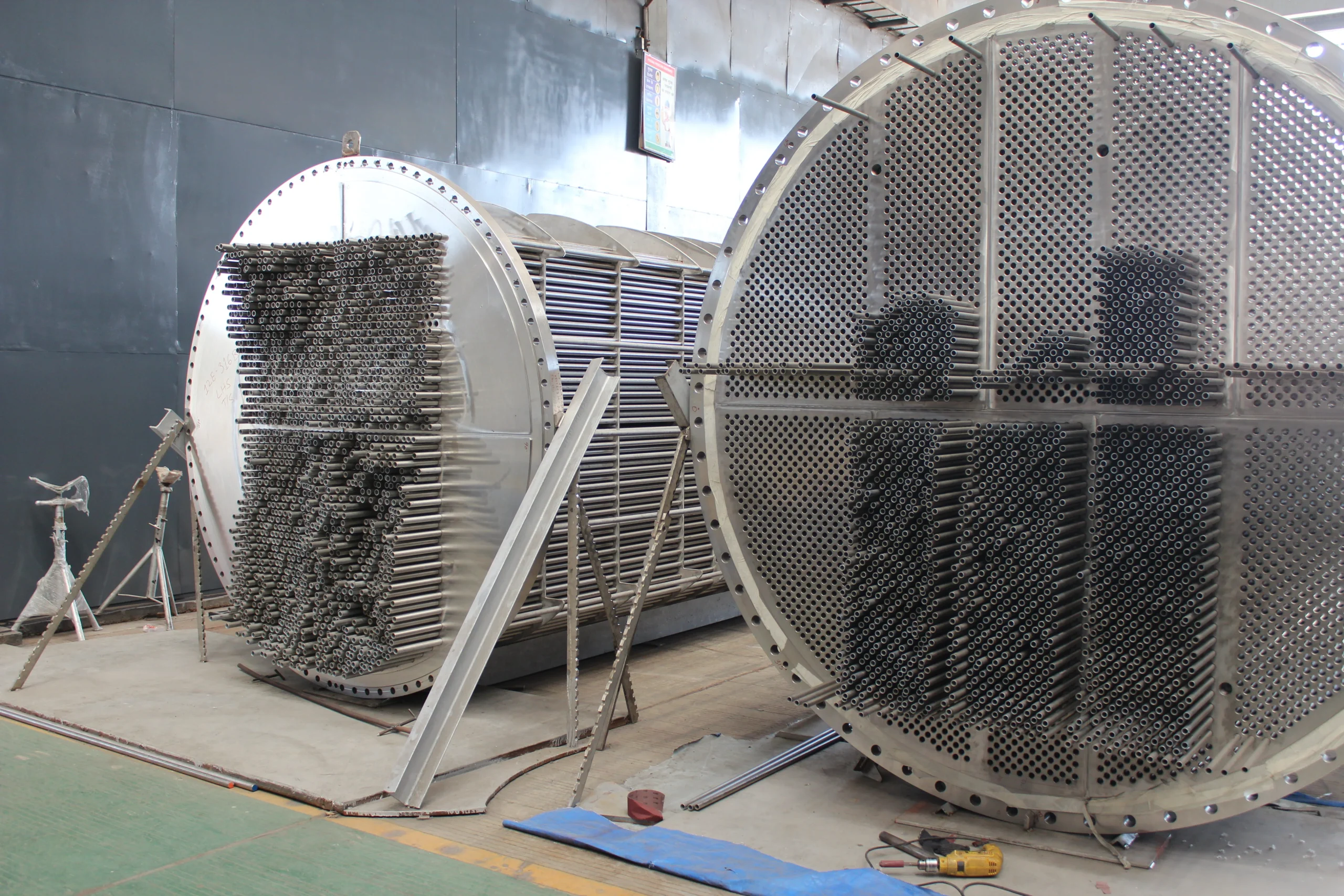
Choosing the Right Material for Industrial Heat Exchangers
Material selection is one of the most important engineering decisions in the design of an industrial heat exchanger. The choice directly affects corrosion resistance, thermal performance, equipment reliability, maintenance requirements and the overall cost of ownership.
In chemical processing, oil and gas, petrochemical, power generation and desalination plants, heat exchangers frequently operate under demanding conditions involving high temperatures, pressure, aggressive chemicals and chloride-rich fluids.
While stainless steel remains a widely used material for industrial heat transfer equipment, certain operating environments can expose its limitations. Pitting corrosion, crevice corrosion and chloride stress corrosion cracking (SCC) can affect equipment integrity, particularly when operating conditions exceed the capabilities of the selected grade.
Titanium offers an alternative for applications requiring higher corrosion resistance, lower material density and reliable performance in many seawater and chloride-containing environments.
But is titanium always better than stainless steel? Not necessarily. The right choice depends on process conditions, metallurgy, equipment design and lifecycle economics.
This guide explores the differences between titanium and stainless steel heat exchangers, including their construction, types, materials, applications, advantages, limitations and engineering considerations.
A titanium vs stainless steel heat exchanger comparison helps engineers evaluate corrosion resistance, thermal performance and lifecycle costs.
Tinita Engineering Pvt. Ltd. specialises in the design and manufacture of industrial heat exchangers and static process equipment using stainless steel, duplex stainless steel and exotic metals such as titanium, tantalum, zirconium, nickel alloys and other corrosion-resistant materials.
With manufacturing facilities at Unit I in Rabale, Navi Mumbai, Maharashtra, and Unit II in Dahej, Gujarat, Tinita Engineering supports industrial projects requiring specialised metallurgy, controlled fabrication and quality-driven manufacturing.
What Is a Titanium Heat Exchanger?
A titanium heat exchanger is industrial heat transfer equipment manufactured using titanium or titanium-alloy components, particularly for applications involving corrosive fluids and demanding operating environments.
Its primary function is to transfer heat between two fluids without allowing them to mix. Depending on the design, heat transfer takes place through tubes, plates or other engineered heat transfer surfaces.
Understanding the differences between a titanium vs stainless steel heat exchanger starts with the materials used in construction.
Titanium is widely considered for heat exchangers because it forms a stable, protective titanium dioxide (TiO₂) film on its surface. This passive layer provides excellent resistance to corrosion in many seawater, chloride-containing and oxidising environments.
Titanium heat exchangers are commonly specified for:
- Seawater cooling systems.
- Desalination plants.
- Chemical processing facilities.
- Marine and offshore installations.
- Power generation plants.
- Pulp and paper processing.
- Chlor-alkali applications.
- Corrosive industrial cooling circuits.
Commercially pure Titanium Grade 2 is a common choice for industrial heat exchanger tubing. Other grades, including Grade 7 and Grade 12, may be selected when specific chemical or mechanical requirements demand them.
Types of Titanium and Stainless Steel Heat Exchangers
The material and heat exchanger configuration are two separate design decisions. Both influence the equipment’s performance, maintenance and suitability for a particular process.
1. Shell and Tube Heat Exchanger
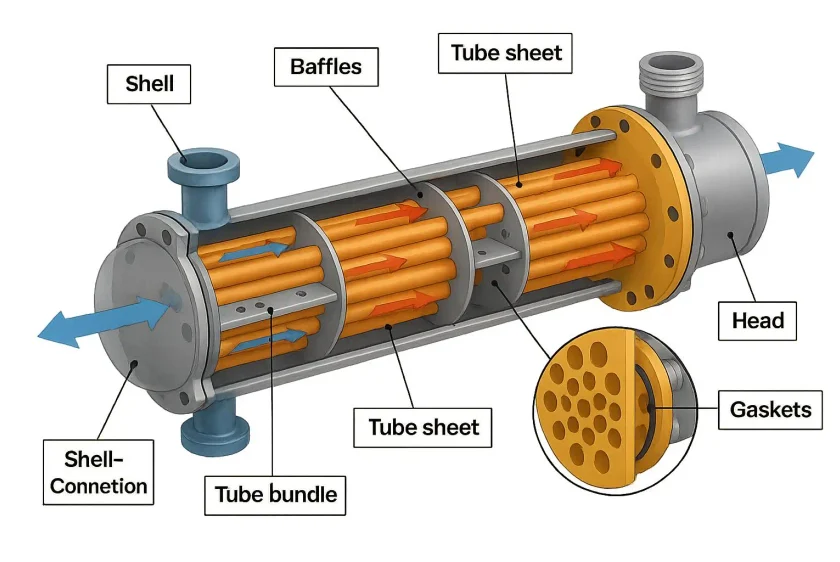
A shell and tube heat exchanger consists of a bundle of tubes enclosed within a cylindrical shell. One fluid flows through the tubes while another flows around them on the shell side.
Depending on the process requirements, the equipment may use fixed tubesheet, U-tube or floating-head construction.
Titanium tubes can be specified for seawater and chloride-containing service, while stainless steel, duplex and other alloys are selected according to the process fluid and design conditions.
2. Double Pipe Heat Exchanger
A double pipe heat exchanger consists of one pipe positioned inside another. One fluid flows through the inner pipe while the second fluid flows through the annular space.
It is suitable for selected smaller-duty applications, high-pressure services and processes requiring relatively simple construction.
3. Hairpin Heat Exchanger
A hairpin heat exchanger uses a U-shaped arrangement of concentric pipes to provide an extended heat transfer path.
It is commonly considered for high-pressure applications, demanding process conditions and installations where modular construction is advantageous.
4. Air-Cooled Heat Exchanger
An air-cooled heat exchanger uses ambient air as the cooling medium, typically with finned tubes and mechanical fans.
It reduces dependence on cooling water and is used in refineries, petrochemical facilities and other industrial installations.
5. Evaporator
An evaporator transfers heat to a liquid, causing it to vaporise. Evaporators are used in chemical processing, concentration systems and other industrial applications.
Material selection depends on the fluid chemistry, temperature, pressure and fouling characteristics.
6. Feedwater Heater
Feedwater heaters use extracted steam or another heating medium to raise boiler feedwater temperature before it enters the boiler system.
They are commonly used in thermal power generation and other steam-based industrial systems.
Materials Used in Titanium and Stainless Steel Heat Exchangers
Selecting the correct material requires an understanding of the available grades, mechanical properties and corrosion behaviour.
Titanium Grades
Titanium Grade 1
Commercially pure titanium with relatively high ductility and good corrosion resistance. It may be selected where formability is important and design loads permit its use.
Titanium Grade 2
One of the most widely used commercially pure titanium grades for industrial equipment. It provides a useful combination of corrosion resistance, moderate mechanical strength and fabricability.
Titanium Grade 7
A palladium-modified titanium grade offering enhanced corrosion resistance in certain reducing and acidic environments compared with commercially pure grades.
Titanium Grade 12
A titanium alloy containing molybdenum and nickel. It offers improved resistance in selected crevice-corrosion and chemical environments.
Stainless Steel Grades
SS 304 / 304L
Used in general industrial applications where moderate corrosion resistance is sufficient.
SS 316 / 316L
Contains molybdenum, improving resistance to pitting and crevice corrosion compared with 304L. Commonly used in chemical and process equipment.
Duplex Stainless Steel 2205
Combines austenitic and ferritic microstructures, providing higher strength and improved resistance to chloride-induced corrosion compared with conventional austenitic stainless steel.
Super Duplex Stainless Steel 2507
Offers higher pitting and crevice corrosion resistance and mechanical strength for demanding industrial environments.
Other Specialised Alloys
Depending on process chemistry, engineers may also evaluate Super Austenitic Stainless Steel, Alloy 20, Inconel, Hastelloy and other nickel-based alloys.
The final material specification should be established using process data, corrosion assessments, mechanical design requirements and applicable project specifications.
Titanium vs Stainless Steel Heat Exchanger: Corrosion Resistance and Chemical Compatibility
Corrosion resistance is one of the primary factors when selecting a titanium vs stainless steel heat exchanger for chemical processing.
How Stainless Steel Performs in Corrosive Environments
Stainless steel develops a passive chromium-rich oxide film that protects its surface from corrosion.
However, this protection has limits. In chloride-containing environments, stainless steel may experience:
- Pitting corrosion.
- Crevice corrosion.
- Chloride stress corrosion cracking.
- Localised corrosion beneath deposits.
- Corrosion associated with stagnant process conditions.
Austenitic stainless steel, particularly 304L and 316L, can be susceptible to chloride SCC when chloride concentration, tensile stress and temperature create favourable conditions.
Temperatures around and above 60°C are often associated with increased risk in chloride-containing service, but 60°C should not be treated as a universal failure threshold.
Duplex and super duplex stainless steels provide improved resistance, although they also require careful material selection and operating-condition assessment.
Why Titanium Performs Differently
Titanium forms a stable and naturally self-repairing titanium dioxide (TiO₂) passive layer.
This protective film provides excellent resistance in many seawater, brine and oxidising environments.
Titanium Grade 2 is particularly well established in seawater heat exchanger applications.
However, titanium is not suitable for every chemical service. Strong reducing acids and fluoride-containing solutions can attack titanium, so chemical compatibility must be checked before material approval.
Engineering consideration: Titanium should be selected based on the complete process chemistry, including fluid concentration, temperature, velocity, contaminants and possible galvanic interactions.
Thermal Conductivity and Heat Transfer Efficiency
A common misconception is that stainless steel automatically transfers heat better than titanium because titanium is more expensive.
The thermal performance of a titanium vs stainless steel heat exchanger depends on tube wall thickness, fluid velocity and fouling resistance.
Actual heat exchanger performance depends on the thermal conductivity of the material, tube wall thickness, fluid velocities, fouling resistance and overall heat transfer coefficient.
Titanium has lower thermal conductivity than copper alloys, but its thermal conductivity is approximately 50% higher than 304 stainless steel according to published titanium engineering data.
Its ability to operate with relatively thin tube walls and little or no conventional corrosion allowance in suitable environments can further reduce wall thermal resistance.
The overall heat transfer relationship is:
1/U = 1/hᵢ + Rfᵢ + Rw + Rfₒ + 1/hₒ
Where:
- U = Overall heat transfer coefficient.
- hᵢ = Tube-side heat transfer coefficient.
- hₒ = Shell-side heat transfer coefficient.
- Rfᵢ and Rfₒ = Fouling resistance.
- Rw = Tube wall thermal resistance.
A thinner tube wall can reduce conductive resistance, but the final wall thickness must satisfy pressure design, mechanical loading, fabrication and inspection requirements.
The thermal design must therefore be evaluated as a complete system rather than by comparing conductivity values alone.
Weight and Structural Advantages of Titanium
Titanium has a density of approximately 4.5 g/cm³, compared with approximately 8.0 g/cm³ for austenitic stainless steel.
For comparable material volumes, titanium offers approximately 44–45% lower material weight.
This can be particularly beneficial for:
- Offshore oil and gas platforms.
- Elevated process equipment.
- Modular process skids.
- Marine installations.
- Space-constrained industrial plants.
The actual equipment weight reduction depends on the complete exchanger construction, including shell, tubesheets, channels, supports and other components.
For large industrial installations, lower weight can influence lifting arrangements, transportation and structural support requirements.
Benefits of Titanium Heat Exchangers
Titanium heat exchangers offer several engineering benefits when specified for suitable applications.
Excellent Corrosion Resistance
The TiO₂ passive film provides protection in many seawater, chloride-containing and oxidising environments.
Resistance to Chloride Stress Corrosion Cracking
Commercially pure titanium offers excellent resistance to chloride SCC, making it suitable for many applications where austenitic stainless steels require additional corrosion assessment.
Lower Material Density
Titanium is approximately 45% lighter than austenitic stainless steel for comparable material volume.
Long-Term Equipment Reliability
Reduced corrosion-related damage can help extend equipment service life and lower maintenance requirements in appropriate operating conditions.
Reduced Corrosion Allowance Requirements
Titanium’s corrosion resistance can permit little or no conventional corrosion allowance in suitable service, subject to design approval.
Suitability for Seawater Applications
Titanium is widely used for seawater cooling, desalination and marine heat transfer applications.
Benefits of Stainless Steel Heat Exchangers
Stainless steel continues to be a practical material for many industrial applications.
Its advantages include:
- Lower initial material cost in many grades.
- Wide commercial availability.
- Established fabrication and inspection practices.
- Good mechanical strength.
- Availability of multiple alloy grades.
- Suitability for a broad range of industrial fluids.
For moderate corrosion conditions, stainless steel can offer an economical and technically suitable solution.
The key is selecting the correct grade rather than assuming that all stainless steels provide equivalent corrosion resistance.
Why Titanium Welding Requires Specialised Fabrication
The performance of a titanium heat exchanger depends not only on the material grade but also on the quality of manufacturing.
Titanium becomes highly reactive with oxygen, nitrogen and hydrogen at elevated temperatures. Atmospheric contamination during welding can lead to embrittlement and reduced mechanical properties.
This is why titanium fabrication requires controlled welding conditions, high-purity inert gas shielding and qualified welding procedures.
Tinita Engineering’s Class 8 Cleanroom Welding Facilities
Tinita Engineering manufactures heat exchangers and specialised process equipment across two state-of-the-art manufacturing facilities equipped with dedicated Class 8 Cleanroom welding zones.
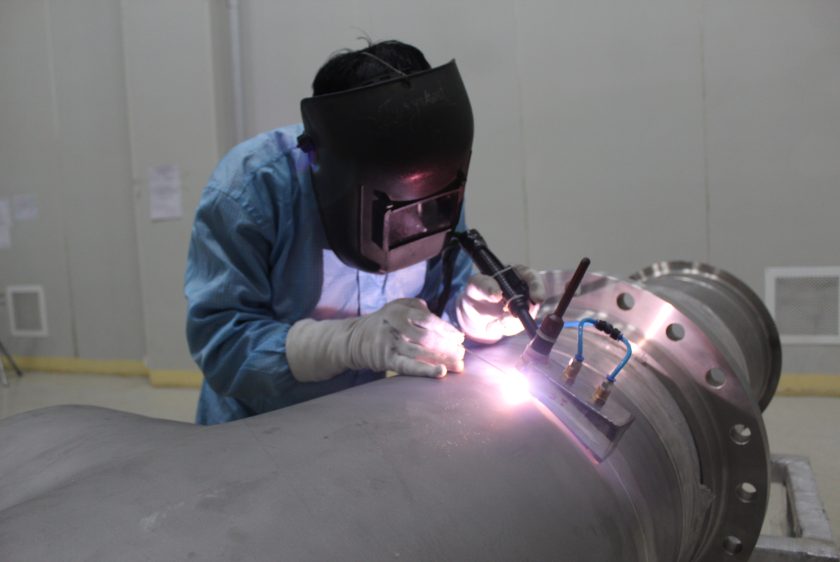
Unit I – Rabale, Navi Mumbai, Maharashtra
Unit II – Dahej, Gujarat
These controlled welding areas are designed to minimise atmospheric contamination during reactive metal welding.
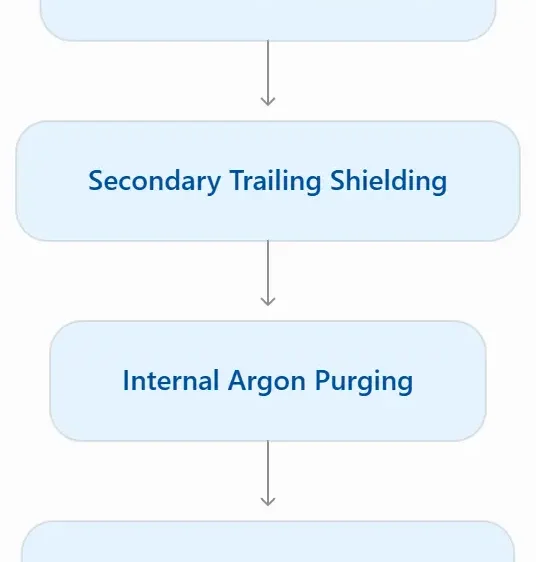
Tinita Engineering follows a three-stage gas shielding approach:
- Primary gas shielding: Protects the welding arc and molten weld pool.
- Secondary gas shielding: Protects the hot weld bead and heat-affected zone during cooling.
- Internal gas purging: Protects the reverse side of the weld where required by the joint configuration.
High-purity argon, controlled shielding arrangements and documented fabrication procedures support the required welding environment.
Qualified WPS/PQR and Traceability
Tinita Engineering follows documented and traceable WPS/PQR procedures and standard operating practices for specialised metal fabrication.
The quality control process supports:
- Material identification and traceability.
- Welding procedure qualification.
- Welder qualification.
- Filler material control.
- Weld inspection and documentation.
- Compliance with applicable project requirements.
The objective is to achieve clean, consistent, silvery weld beads while meeting the required metallurgical and inspection criteria.
Titanium vs Stainless Steel Heat Exchanger
The following comparison highlights the engineering differences between a titanium vs stainless steel heat exchanger.
| Parameter | Titanium Heat Exchanger | Stainless Steel Heat Exchanger |
|---|---|---|
| Material density | Approximately 4.5 g/cm³ | Approximately 8.0 g/cm³ for 316L |
| Corrosion resistance | Excellent in many chloride environments | Depends on grade and process conditions |
| Seawater service | Highly suitable | Grade-dependent; limitations in many seawater duties |
| Chloride SCC | Excellent resistance for commercially pure grades in suitable service | Austenitic grades can be susceptible |
| Thermal conductivity | Higher than 304 stainless steel | Lower than titanium for 304 stainless |
| Initial material cost | Generally higher | Generally lower |
| Fabrication | Requires specialised inert shielding | Established conventional welding practices |
| Maintenance | Potentially lower in suitable corrosive service | Depends on corrosion and operating conditions |
| Weight | Lower | Higher |
| Typical application | Seawater, desalination and aggressive chloride service | General chemical and industrial applications |
Titanium vs Stainless Steel: Which Material Is Better for Different Applications?
| Industrial Application | Potential Material Selection | Engineering Reason |
|---|---|---|
| General industrial cooling | SS 316L | Economical for suitable water chemistry |
| Moderate chloride exposure | Duplex 2205 | Improved chloride-related corrosion resistance |
| High chloride cooling water | Super Duplex or Titanium | Requires temperature and chemistry evaluation |
| Seawater cooling | Titanium | Excellent seawater corrosion resistance |
| Desalination | Titanium | Suitable for many seawater and brine duties |
| Marine cooling | Titanium | Corrosion resistance and lower material density |
| General chemical processing | SS 316L / Duplex | Depends on process chemistry |
| Selected oxidising acid service | Titanium | Excellent resistance in compatible media |
| Fluoride-containing chemical service | Specialised alternative alloy | Titanium may be unsuitable |
Applications of Titanium and Stainless Steel Heat Exchangers
A titanium vs stainless steel heat exchanger can serve different applications depending on the process fluid and operating conditions.
Chemical Processing Industry
Chemical plants require heat exchangers for heating, cooling, condensation and temperature control.
Stainless steel, duplex and exotic metals are selected according to the chemical composition and operating environment.
Oil and Gas Industry
Heat exchangers are used in refining, gas processing, hydrocarbon cooling and condensation systems.
Material selection must consider process fluid composition, operating temperature, pressure and corrosion mechanisms.
Petrochemical Industry
Petrochemical plants use different heat exchanger configurations for process heating, cooling, recovery and condensation.
Titanium and higher-alloy materials may be considered where corrosion resistance is a major requirement.
Desalination and Marine Industry
Seawater and concentrated brine create demanding corrosion conditions. Titanium is frequently selected for heat exchanger tubes and other wetted components.
Power Generation
Condensers and feedwater heaters are important components of thermal power systems.
Titanium can be considered for seawater-cooled condenser applications, while stainless steel and other materials are selected according to the cooling medium and process requirements.
Pulp and Paper Industry
Bleaching and chemical recovery processes may expose equipment to aggressive chemicals and chloride-containing fluids. Material selection depends on the particular process stage and chemical composition.
Total Cost of Ownership: Initial Cost vs Long-Term Performance
A stainless steel heat exchanger may have a lower initial procurement cost compared with a titanium alternative.
However, the initial price alone does not represent the total investment over the equipment’s operating life.
In aggressive process conditions, corrosion-related maintenance, tube replacement, shutdowns and production losses can increase lifecycle expenses.
Titanium may require higher initial capital expenditure, but its corrosion resistance can help reduce maintenance and replacement costs in suitable applications.
A proper Total Cost of Ownership assessment should consider:
- Initial equipment cost.
- Engineering and fabrication expenses.
- Installation and commissioning.
- Expected service life.
- Inspection and maintenance.
- Production downtime.
- Replacement requirements.
- Long-term operating reliability.
The best material is the one that meets the process requirements and delivers the most suitable lifecycle economics.
Frequently Asked Questions (FAQs)
1. What is the main difference between titanium and stainless steel heat exchangers?
The main difference is their corrosion resistance, density and fabrication requirements. Titanium offers excellent resistance in many chloride-containing environments and lower material density, whereas stainless steel generally provides a lower initial cost and broad industrial applicability.
2. Is titanium better than SS 316L for seawater heat exchangers?
Titanium Grade 2 generally offers significantly better corrosion resistance in seawater than SS 316L. It is widely used in seawater-cooled heat exchangers and condensers where chloride-related corrosion is a concern.
3. What is the best titanium grade for industrial heat exchangers?
Titanium Grade 2 is a common choice for industrial heat exchanger tubing because of its corrosion resistance, mechanical properties and fabricability. Grades 7 and 12 may be selected for specific chemical and crevice-corrosion requirements.
4. Can titanium heat exchangers handle high temperatures?
Titanium can be used in elevated-temperature applications, but the permissible operating conditions depend on the grade, pressure, mechanical properties, process chemistry and design code. The material should be evaluated against actual operating and design conditions.
5. Why is titanium used in desalination plants?
Titanium offers excellent resistance to seawater and many chloride-containing brine environments. This makes it suitable for selected heat exchangers, condensers and other equipment used in desalination plants.
6. Does titanium have better thermal conductivity than stainless steel?
Yes. Titanium generally has higher thermal conductivity than 304 stainless steel. However, actual heat exchanger efficiency also depends on tube wall thickness, fluid-side heat transfer coefficients, fouling and equipment configuration.
7. Why does titanium welding require a cleanroom?
Titanium reacts readily with oxygen and nitrogen at elevated welding temperatures. Controlled fabrication conditions and inert gas shielding help prevent contamination, embrittlement and deterioration of weld properties.
8. What is a Class 8 Cleanroom welding zone?
A Class 8 cleanroom is a controlled environment classified under ISO 14644-1 based on airborne particle concentration. In titanium fabrication, a controlled cleanroom environment helps minimise particulate contamination. It does not independently guarantee protection from oxygen or nitrogen contamination; qualified inert gas shielding remains essential.
9. Are titanium heat exchangers more expensive than stainless steel?
Generally, yes. Titanium has a higher initial material cost. However, in suitable corrosive applications, reduced maintenance and longer service life can make it economically attractive over the equipment’s operating life.
10. Which heat exchanger manufacturer provides titanium and exotic metal fabrication in India?
Tinita Engineering Pvt. Ltd. manufactures industrial heat exchangers and static process equipment using titanium, stainless steel, duplex stainless steel and other exotic metals. Its manufacturing facilities are located at Rabale, Navi Mumbai, and Dahej, Gujarat, with dedicated Class 8 Cleanroom welding zones.
11. Can titanium and stainless steel be used together in one heat exchanger?
Yes. Depending on the design, titanium tubes may be combined with other structural materials or clad components. However, galvanic corrosion, joint design, tube-to-tubesheet connections and isolation requirements must be evaluated.
12. What information is required to select the right heat exchanger material?
Important inputs include process fluid composition, chloride concentration, operating and design temperature, operating and design pressure, flow rates, heat duty, corrosion requirements and applicable design codes.
Select the Right Heat Exchanger Material with Tinita Engineering
Selecting the right titanium vs stainless steel heat exchanger requires evaluating process conditions, material compatibility and total cost of ownership.
Stainless steel remains an economical and reliable option for many general industrial duties. Titanium offers significant advantages in applications involving seawater, aggressive chloride environments and corrosion-sensitive process systems.
At Tinita Engineering Pvt. Ltd., we combine specialised metallurgy, heat exchanger manufacturing capabilities and controlled exotic metal fabrication to support demanding industrial applications.
Our facilities at Rabale, Navi Mumbai, and Dahej, Gujarat, are equipped with dedicated Class 8 Cleanroom welding zones for specialised reactive metal fabrication.
Whether your requirement involves titanium, SS 316L, Duplex, Super Duplex or other corrosion-resistant materials, our technical team can assist with application-specific equipment requirements.
Looking for a titanium or stainless steel heat exchanger manufacturer in India?
Contact Tinita Engineering’s technical sales team to discuss your process requirements, technical specifications and custom ASME/TEMA-compliant heat exchanger fabrication.



 English