
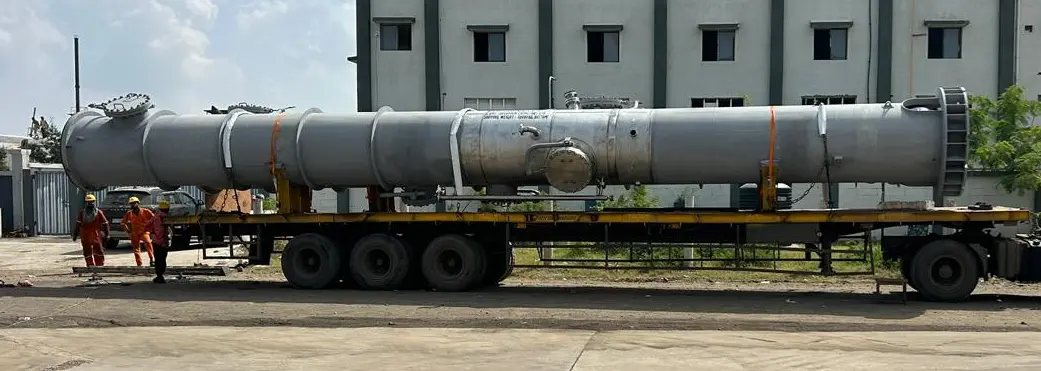
When a process plant needs to separate, purify, absorb, strip, cool or condition a process stream, the column is often one of the most important pieces of static equipment in the system. A column may look like a simple vertical vessel from the outside, but its internal arrangement, metallurgy, mechanical design and fabrication quality directly influence process performance and operating reliability. In industries such as oil & gas, petrochemicals, fertilizers, chemicals, specialty chemicals, pulp & paper and power & energy, process columns are designed around specific operating conditions rather than manufactured as generic equipment.
At Tinita Engineering Pvt. Ltd., process columns are developed as custom-engineered static process equipment for demanding industrial applications. Our column manufacturing portfolio includes distillation columns, fractional distillation columns, quench columns, azeotropic distillation columns, packed and vacuum distillation columns, absorption columns and stripping columns. Tinita also works with specialized materials including Titanium, Tantalum, Zirconium, Hastelloy and Duplex Stainless Steel, along with clad construction for applications requiring corrosion-resistant process surfaces.
The interesting part of process-column engineering is that there is no universal design that works for every plant. A column handling a hydrocarbon separation service may require a very different configuration from one processing an aggressive chemical stream. Diameter, height, pressure, temperature, vacuum conditions, feed characteristics, internal configuration, material of construction and fabrication method all need to be considered together.
This article explains how process columns are selected, designed and fabricated, the major column types used in industry, the importance of metallurgy, and what project teams should consider when selecting a process column manufacturer.
What Are Process Columns?
Process columns are vertical static equipment used to perform separation or mass-transfer operations between process streams. Depending on the application, a column can separate components based on differences in volatility, transfer a component between gas and liquid phases, remove volatile substances from a liquid, or rapidly cool and condition a hot gas stream.
Inside the vessel, the process streams are brought into controlled contact using trays, structured packing, random packing, distributors, redistributors, demisters and other column internals. The internal arrangement is selected according to the process duty, required separation efficiency, hydraulic conditions and operating range.
A typical separation column can include several functional zones. Feed may enter at a specified elevation, while the column contains a rectification or absorption section above the feed and a stripping section below it. Depending on the process, the bottom may connect to a reboiler and the top to a condenser or overhead system.
The external vessel is therefore only one part of the equipment. The real engineering challenge lies in integrating the pressure boundary, internal components, nozzles, supports, metallurgy and process requirements into one reliable system.
For this reason, selecting a process column manufacturer should involve more than checking vessel fabrication capacity. The manufacturer should understand the relationship between process requirements, mechanical design, materials and fabrication.
Why Are Process Columns Important in Industrial Plants?
A process column is often positioned at a critical point in a production sequence. If its separation efficiency falls, the effect can travel downstream through the plant. Poor separation may increase energy consumption, affect product purity, overload downstream equipment or require additional processing.
Consider a distillation system. The column must provide sufficient vapor-liquid contact for the desired separation while remaining within acceptable pressure-drop and hydraulic limits. The number and type of theoretical stages, reflux conditions, feed characteristics and internal configuration all influence the required equipment.
The same principle applies to absorption and stripping. The objective is not simply to provide a tall vessel; the equipment must create the required contact between phases under the specified operating conditions.
This is why process column fabrication begins long before welding starts. Process information must be translated into a mechanical and fabrication specification that the manufacturing team can execute accurately.
A well-engineered column therefore brings together several disciplines:
- Process engineering
- Mechanical engineering
- Materials engineering
- Structural engineering
- Welding engineering
- Inspection and quality control
- Fabrication and assembly
When these disciplines work together, the final equipment is better positioned to achieve the required operating performance and service life.
Types of Process Columns
Different separation and conditioning duties require different column configurations. At Tinita Engineering, the column portfolio includes several configurations designed for specific industrial services.
Distillation Columns
Distillation columns are used to separate components based primarily on differences in volatility. A feed mixture enters the column and is exposed to repeated vapor-liquid contact, allowing more volatile components to preferentially move toward the overhead section while less volatile components concentrate toward the bottom.
The exact arrangement depends on the process. A distillation column may include trays or packing, feed distributors, liquid distributors, demisters, downcomers, reboiler connections and overhead vapor outlets.
Tinita Engineering manufactures custom-engineered distillation columns for applications across oil & gas refineries, petrochemical, fertilizer, chemical, pulp & paper and power & energy industries. our capability includes columns up to 5200 mm diameter, 40 m inner diameter length and 89 tonnes weight, subject to project requirements.
Fractional Distillation Columns
A fractional distillation column is used when a feed contains multiple components that need to be separated into fractions with different boiling characteristics. The repeated vapor-liquid equilibrium stages provided by trays or packing allow the process to achieve a higher degree of separation than a simple single-stage vaporization and condensation arrangement.
Fractional distillation is widely associated with petroleum refining and petrochemical processing, but the underlying separation principle is applicable across many chemical and industrial processes.
Column diameter, height, internal arrangement, reflux, feed condition and thermal duty all influence the final equipment design. The manufacturer must also consider how the internal components will be installed, supported, inspected and maintained.
Vacuum Distillation Columns
Vacuum distillation columns operate below atmospheric pressure to allow separation at lower boiling temperatures. This can be useful when the process material is temperature sensitive or when operating at atmospheric pressure would require an undesirable temperature.
Vacuum service introduces a different mechanical-design challenge. The column may be subjected to external pressure rather than simply internal pressure, making resistance to buckling and stability an important part of the design.
Shell thickness, stiffening arrangements, geometry, support configuration, operating temperature and vacuum conditions therefore need to be evaluated as part of the engineering design.
Tinita’s portfolio includes Packed & Vacuum Distillation Columns, with design and certification information on its product page.
Stripping Columns
A stripping column is used to remove volatile components from a liquid stream. Depending on the process, steam or another stripping medium can move counter-currently through the liquid to facilitate the transfer of volatile components into the vapor phase.
Stripping columns can use packed or tray configurations. The appropriate design depends on the feed properties, separation target, temperature, pressure, allowable pressure drop and required mass-transfer performance.
Tinita’s stripping-column application describes services involving removal of volatile hydrocarbons and low-boiling components, with tray or packed configurations depending on the application.
Absorption Columns
An absorption column transfers one or more components from a gas stream into a liquid solvent. Unlike distillation, which primarily separates components based on volatility, absorption relies on differences in solubility and mass transfer between the gas and liquid phases.
The column may use structured packing, random packing or trays depending on the process. Liquid distribution becomes particularly important in packed columns because poor distribution can reduce the effective mass-transfer area.
For corrosive gas-treatment services, material selection can become a major part of the equipment specification. Depending on the process chemistry, engineers may evaluate stainless steels, Duplex grades, Nickel Alloys, Titanium, Zirconium or other specialized materials.
Quench Columns
A quench column performs rapid cooling and conditioning of hot process gases, commonly using direct contact with a cooling liquid. The sudden temperature reduction can also facilitate condensation or removal of selected components from the gas stream.
Tinita’s Quench Column information describes direct-contact cooling of hot gases and applications across refinery, petrochemical, fertilizer, chemical, pulp & paper and power & energy industries.
Azeotropic Distillation Columns
Some mixtures form azeotropes, meaning conventional distillation cannot achieve the desired separation in the normal way. Azeotropic distillation columns are designed for specialized separation systems where an entrainer or another process strategy may be used to alter the separation behavior.
These columns require close coordination between process design and mechanical equipment design. The column internals, operating conditions, metallurgy and ancillary equipment must all be compatible with the process scheme.
Tinita Engineering lists Azeotropic Distillation Columns within its column portfolio for industrial applications.
Tray Columns vs Packed Columns
One of the important decisions in column engineering is whether the equipment should use trays or packing.
Tray columns provide discrete stages of vapor-liquid contact. They may be suitable for applications requiring particular capacity, liquid handling or operational characteristics. Tray selection can involve considerations such as tray type, spacing, downcomer arrangement, weir configuration and allowable pressure drop.
Packed columns provide continuous contact over packing surfaces. Structured or random packing can provide a large surface area for mass transfer, while distributors and redistributors are essential for maintaining appropriate liquid distribution.
There is no universal answer that says packing is always better than trays. The selection depends on the process duty, flow rates, pressure drop, fouling tendency, liquid and vapor properties, operating range and maintenance requirements.
For a custom process column manufacturer, the key is to fabricate the mechanical equipment accurately around the process design rather than forcing the process into a standard mechanical configuration.
Process Column Design Considerations
The design of a process column begins with the process specification and ends with a fabricated pressure boundary capable of safely handling the defined service. Several engineering parameters must be considered together.
Diameter and Height
Column diameter is influenced by vapor and liquid flow rates, flooding limits, pressure drop and the selected internals. Column height is influenced by separation requirements, number of stages, packing height, tray spacing, disengagement requirements and internal arrangements.
A larger diameter does not automatically mean better performance. Similarly, a taller column is not necessarily more efficient if the internals and hydraulic design are inappropriate.
The final dimensions should therefore come from the process design and mechanical requirements.
Design Pressure and Temperature
The design pressure and temperature define critical mechanical requirements for the vessel. Internal-pressure service requires adequate pressure-boundary thickness, while vacuum service requires careful assessment of external-pressure stability.
ASME BPVC Section VIII Division 1 provides requirements for the design, fabrication, inspection, testing and certification of pressure vessels operating at internal or external pressures above specified thresholds.
Where an ASME-certified pressure vessel construction is specified, the applicable code edition, design basis, materials, welding, inspection and documentation must be managed within the project’s quality system.
Wind and Seismic Loads
Large vertical columns can present significant wind and seismic loading because of their height and exposed surface area. The vessel shell, skirt, support arrangement, anchor bolts and foundation interface need to be evaluated accordingly.
These loads are especially important for tall equipment installed in exposed industrial facilities.
Nozzles and Connections
Nozzle orientation and size are driven by process requirements, piping layout, maintenance access and mechanical considerations. Large nozzles can also introduce local stresses into the vessel shell.
Therefore, nozzle design should be coordinated between process, piping and mechanical engineering teams.
Internal Supports
Internal components require appropriate support systems. Trays, packing supports, distributors, demisters and other internals must remain stable under operating and maintenance conditions.
For exotic-metal construction, internal support details may also require careful consideration of material compatibility and fabrication methods.
Process Column Internals
The vessel shell provides the pressure boundary, but column internals perform much of the actual process work.
Depending on the application, internals can include:
- Tray decks
- Downcomers
- Structured packing
- Random packing
- Packing support grids
- Liquid distributors
- Liquid redistributors
- Feed distributors
- Demisters
- Spray rings
- Baffles
- Dip tubes
- Internal support rings
The internal design determines how effectively the phases contact one another.
For example, poor liquid distribution in a packed column can result in channeling, reducing the effective area available for mass transfer. Similarly, incorrect tray design can affect capacity, pressure drop and separation performance.
This is particularly important for exotic metal process columns, where the internal components may themselves require corrosion-resistant metallurgy or clad construction.
Tinita’s column capability specifically references advanced configurations incorporating internal baffles, dip tubes, spray rings and explosive cladding for selected applications.
Materials of Construction for Process Columns
Material selection is one of the most important decisions in process column engineering.
The correct metallurgy depends on:
- Process chemistry
- Chemical concentration
- Operating temperature
- Design temperature
- Pressure
- Vacuum conditions
- Chloride content
- Contaminants
- Corrosion mechanisms
- Erosion potential
- Cleaning conditions
- Expected service life
A material should not be selected simply because it is classified as an “exotic metal.” It needs to be compatible with the actual process environment.
For equipment intended for applicable European markets, the Pressure Equipment Directive (PED) should be evaluated according to the equipment category, design conditions and applicable conformity-assessment requirements.
For demanding chemical services, Tinita Engineering’s material expertise includes Titanium, Tantalum, Zirconium, Hastelloy and Duplex Stainless Steel.
Titanium Columns
Titanium columns can be considered where corrosion resistance and material performance make Titanium appropriate for the process environment.
Titanium can be particularly relevant in selected chemical services where conventional steels may not provide adequate corrosion resistance. However, the correct grade and construction must be established against the actual process conditions.
Titanium fabrication also requires controlled welding and handling practices. Material cleanliness, shielding and traceability are important considerations during fabrication.
For applications involving Titanium process-contact surfaces, the equipment design should integrate material selection with fabrication and inspection from the beginning.
Tantalum Columns
Tantalum columns are highly specialized process equipment for selected aggressive chemical environments where exceptional corrosion resistance is required.
Because Tantalum is a premium material, engineers generally consider it where its corrosion performance provides a meaningful technical benefit. It may also be incorporated selectively through specialized lining or clad construction rather than being used for every structural component.
This creates a close relationship between Tantalum fabrication, cladding, lining and column internals.
For a Tantalum-lined or clad column, the integrity of the corrosion-resistant layer is as important as the mechanical strength of the underlying structure.
Zirconium Columns
Zirconium columns are used in specialized chemical-processing services where Zirconium’s corrosion resistance is suitable for the specified environment.
As with Titanium and Tantalum, Zirconium requires controlled fabrication practices. Welding, forming, contamination control, material traceability and inspection must be considered throughout manufacturing.
For aggressive chemical services, the material selection should be supported by process chemistry and appropriate corrosion data rather than relying solely on generic material descriptions.
Hastelloy Columns
Hastelloy columns can provide a solution for process environments requiring corrosion resistance from high-performance Nickel Alloys.
The term Hastelloy covers multiple alloy grades, each with its own characteristics. Therefore, the exact grade should be selected according to the process conditions.
Fabrication requires appropriate welding procedures, heat-input control, material identification and inspection. These factors become particularly important for large custom-fabricated process equipment.
Duplex Stainless Steel Columns
Duplex Stainless Steel columns combine high strength with corrosion resistance and can be considered for applications where these characteristics are important.
Super Duplex grades may be considered for more demanding corrosion services where the specified chemistry and design conditions justify their selection.
Welding control is especially important with Duplex and Super Duplex materials because the fabrication thermal cycle can influence the resulting microstructure and properties.
Clad Process Columns
Clad construction can be an effective engineering approach when a process requires corrosion resistance at the wetted surface while the equipment also requires a structurally efficient base material.
Instead of manufacturing the complete column from a premium corrosion-resistant alloy, the corrosion-resistant material can be applied or bonded to the relevant surface according to the specified construction method.
Depending on the design, technologies can include explosion cladding, weld overlay and other clad-metal construction methods.
This can be particularly relevant to large process columns because the quantity and cost of exotic alloy can be substantial. The objective is to achieve the required corrosion resistance without unnecessarily increasing the quantity of premium material.
For Tinita, this is an important part of the broader exotic metal fabrication capability.
Exotic Metal Fabrication for Process Columns
Fabricating a large carbon-steel vessel is very different from fabricating a column involving reactive metals or high-performance alloys.
Exotic metal fabrication requires control at every stage, from material receipt to final inspection.
The fabrication process may involve:
Material verification → cutting → forming → fit-up → welding → heat treatment where applicable → machining → internal assembly → inspection → testing → documentation
Material traceability becomes particularly important. Heat numbers, material certificates, welding consumables, procedures and inspection records need to remain linked to the equipment documentation.
Welding requirements also vary substantially between materials. Titanium, Zirconium, Tantalum, Nickel Alloys and Duplex Stainless Steels each have their own fabrication considerations.
For this reason, the manufacturer’s experience with the specific metallurgy matters just as much as its general vessel-fabrication capacity.
Process Column Fabrication at Tinita Engineering
At Tinita Engineering, process columns are manufactured as custom-engineered static process equipment rather than standard off-the-shelf vessels.
The column capability covers diameters up to 5200 mm, inner diameter lengths up to 40 metres and weights up to 89 tonnes, subject to project-specific requirements. Tinita also states that its columns are manufactured in compliance with major international design standards and ASME codes.
The manufacturing approach needs to connect engineering with fabrication. A column drawing is not simply a dimensional document; it represents the relationship between the pressure boundary, internals, nozzles, supports, materials and process requirements.
For large equipment, dimensional control is equally important. Shell roundness, straightness, nozzle orientation, internal support locations and assembly tolerances can affect installation and operation.
The final equipment therefore requires coordinated engineering, fabrication, welding, inspection and quality documentation.
Codes, Standards and Certification
The applicable codes and standards depend on the project specification, jurisdiction, service and equipment classification.
For pressure-containing equipment, ASME BPVC Section VIII is one of the major international code frameworks used for pressure-vessel construction. ASME describes Section VIII Division 1 as covering design, fabrication, inspection, testing and certification of pressure vessels.
ASME’s current certification information also identifies U certification for Section VIII Division 1 pressure vessels, with separate certification routes for other divisions and scopes.
For a project, however, “ASME compliant” should never be treated as a complete engineering specification by itselidentifies ASME U Stamp certification and PED among its standards and certifications for the column portfolio.
Where equipment is supplied for the European market, the applicable Pressure Equipment Directive (PED) requirements should be established according to the equipment category, fluid group, design conditions and conformity-assessment route.
Inspection and Quality Control
Inspection is an integral part of process column manufacturing.
The inspection plan depends on the project specification and applicable code, but may include:
- Material identification and traceability
- Dimensional inspection
- Visual examination
- Weld inspection
- Non-destructive examination
- Pressure testing
- Leak testing
- Vacuum testing where applicable
- Internal inspection
- Final documentation review
For exotic-metal columns, inspection may also focus on the integrity of corrosion-resistant surfaces, clad interfaces, welds and lining systems.
The purpose is not simply to generate documentation. Inspection provides evidence that the fabricated equipment conforms to the approved drawings, materials, procedures and applicable requirements.
A strong quality-control system therefore begins at material receipt and continues until final dispatch.
Applications of Process Columns
Process columns are used across a broad range of industries.
Oil & Gas
Refineries and hydrocarbon-processing facilities use columns for fractionation, separation, stripping, absorption and other process operations.
Petrochemical
Petrochemical plants use distillation and separation systems to process feedstocks and intermediate products.
Chemical Processing
Chemical plants often require columns capable of handling corrosive and chemically aggressive process streams. Material selection can therefore become a major part of the equipment design.
Fertilizer
Fertilizer processes can involve elevated temperatures, pressure and corrosive chemical environments, creating requirements for specialized static equipment.
Specialty Chemicals
Specialty chemical processes may involve highly specific separation requirements and challenging chemistries, making custom engineering particularly important.
Pulp & Paper
Certain chemical recovery and treatment processes require separation, absorption, stripping or gas-conditioning equipment.
Power & Energy
Process columns can be used in chemical treatment and conditioning systems associated with energy facilities.
Tinita’s column portfolio identifies oil & gas refineries, petrochemicals, fertilizers, chemicals, pulp & paper and power & energy among its application sectors.
How to Select a Process Column Manufacturer
Choosing the right process column manufacturer is an engineering decision, not simply a purchasing decision.
A manufacturer should be evaluated on its ability to understand the complete equipment requirement.
Engineering Capability
Can the manufacturer work with the process design and translate it into a practical mechanical equipment design?
Metallurgy Expertise
Can the manufacturer fabricate the required material rather than simply purchase and subcontract it?
Fabrication Capacity
Does the facility have sufficient capacity for the required diameter, length, weight and handling requirements?
Welding Capability
Are suitable procedures and qualified personnel available for the specified materials?
Internal Fabrication
Can the manufacturer fabricate and install trays, packing supports, distributors, baffles, dip tubes, spray rings and other internal components?
Inspection
Can the manufacturer execute the required NDE, testing and dimensional inspection?
Certification
Can the equipment be manufactured to the applicable ASME, PED, IBR or project-specific requirements?
Documentation
Can the manufacturer provide material certificates, welding records, inspection reports, testing documentation and final manufacturing records?
These questions become especially important for custom process columns, where equipment dimensions and construction details are developed around a specific process.
Process Columns vs Standard Pressure Vessels
A process column is a pressure-containing vessel in many applications, but it is more than a simple storage or containment vessel.
A storage vessel primarily holds a material. A process column actively performs a process function through its internal configuration.
That means a column may require:
- Carefully designed internals
- Feed distribution
- Vapor-liquid contact
- Mass-transfer stages
- Liquid collection
- Reflux distribution
- Demisting
- Internal supports
- Multiple process nozzles
- Reboiler and condenser connections
The mechanical vessel and the process internals therefore have to be designed as one integrated system.
This is one reason why choosing a manufacturer with both static equipment fabrication and process-equipment understanding can be valuable.
Why Material Expertise Matters in Process Columns
The material selected for a column can directly influence its reliability, maintenance requirements and service life.
A column operating with a relatively mild hydrocarbon stream may require a different metallurgy from one handling an aggressive acid or chloride-containing chemical.
In corrosive services, an apparently small material-selection error can eventually become a major operating issue. Corrosion can affect shell thickness, internal components, nozzles, trays, packing supports and other wetted surfaces.
This is where Tinita’s broad material capability becomes relevant. The company identifies Titanium, Tantalum, Zirconium, Hastelloy and Duplex Stainless Steel within its column material expertise.
The engineering goal should always be to select the most appropriate metallurgy for the actual service—not simply the most expensive or exotic material available.
Why Choose Tinita Engineering for Process Columns?
Tinita Engineering Pvt. Ltd. manufactures custom-engineered process columns for demanding industrial applications, combining static equipment manufacturing with specialized metallurgy and fabrication capability.
The company capabilities for large-diameter and long-length columns and lists applications across major process industries. Its portfolio includes distillation, fractional distillation, quench, azeotropic distillation, packed and vacuum distillation, absorption and stripping columns.
The material portfolio includes:
Titanium | Tantalum | Zirconium | Hastelloy | Duplex Stainless Steel | Clad Construction
This combination is particularly relevant for projects where process conditions require more than conventional fabrication.
The focus should always remain on the project requirement: process duty, equipment geometry, metallurgy, design conditions, fabrication method, inspection requirements and applicable standards.
For EPC contractors, process licensors and plant owners, that engineering approach can simplify the transition from process specification to finished static equipment.
Final Thoughts
Process columns are among the most important static equipment used in separation, purification, absorption, stripping and gas-conditioning applications. Their performance depends on much more than the external vessel dimensions. Internal configuration, process conditions, mechanical design, metallurgy, welding, inspection and fabrication quality all contribute to the final equipment.
From distillation and fractional distillation to vacuum distillation, stripping, absorption, quench and azeotropic separation, each column type has its own engineering requirements. The correct configuration depends on the process duty, while the correct metallurgy depends on the actual service environment.
For demanding applications, materials such as Titanium, Tantalum, Zirconium, Hastelloy and Duplex Stainless Steel can provide specialized solutions where corrosion resistance, strength or other material characteristics are required. Clad construction can also provide an engineered combination of structural material and corrosion-resistant process-contact surfaces.
At Tinita Engineering Pvt. Ltd., process columns are manufactured as custom-engineered static equipment for industries including oil & gas, petrochemical, fertilizer, chemical, pulp & paper and power & energy. The company’s portfolio covers multiple column configurations and specialized metallurgies, with large-equipment manufacturing capabilities for project-specific requirements.
The right process column is ultimately not defined by its size alone. It is defined by how well its process duty, design, materials, internals and fabrication work together.
Frequently Asked Questions About Process Columns
What are process columns?
Process columns are vertical static equipment used for separation, absorption, stripping, fractionation, quenching and other mass-transfer or gas-conditioning operations. They use internal components such as trays, packing, distributors and demisters to achieve the required process performance.
What are the main types of process columns?
Common types include distillation columns, fractional distillation columns, vacuum distillation columns, stripping columns, absorption columns, quench columns and azeotropic distillation columns. The appropriate type depends on the process duty.
Which materials are used to manufacture process columns?
Process columns can be manufactured from carbon steel, stainless steels, Duplex and Super Duplex stainless steels, Nickel Alloys and specialized materials such as Titanium, Tantalum and Zirconium. Clad construction may also be used where corrosion-resistant process surfaces are required.
What is the difference between a distillation column and an absorption column?
A distillation column separates components primarily through differences in volatility and repeated vapor-liquid contact. An absorption column transfers selected components from a gas phase into a liquid solvent based on mass-transfer and solubility behavior.
What is a stripping column used for?
A stripping column is used to remove volatile components from a liquid stream. Steam or another stripping medium may be used to facilitate transfer of volatile components into the vapor phase.
Why are exotic metals used in process columns?
Exotic metals such as Titanium, Tantalum, Zirconium and Nickel Alloys may be selected when the process environment presents demanding corrosion, temperature or mechanical requirements. The final material should always be selected according to the actual process conditions.
What is a vacuum distillation column?
A vacuum distillation column operates below atmospheric pressure, allowing certain materials to be separated at lower boiling temperatures. Mechanical design must account for external-pressure stability and vacuum conditions.
What should I consider when selecting a process columns manufacturer?
Consider the manufacturer’s engineering capability, metallurgy expertise, fabrication capacity, welding qualifications, internal fabrication capability, inspection systems, applicable certifications, quality control and documentation experience



 English