
When industrial equipment has to deal with aggressive chemicals, high temperatures, pressure, chlorides, acids, or other demanding process conditions, choosing the right material is not simply a matter of selecting a stronger metal. The real challenge is finding a material and fabrication method that can provide corrosion resistance, mechanical strength, reliability, and long service life without making the equipment unnecessarily expensive. This is where exotic metal fabrication, clad metals, explosion clad, and weld overlay cladding become especially important.
At Tinita Engineering Pvt. Ltd., we work with a wide range of high-performance metallurgies for critical static process equipment, including Titanium, Tantalum, Zirconium, Nickel Alloys, Duplex & Super Duplex Stainless Steels, and Clad Metals. Our fabrication expertise covers equipment such as Heat exchangers, reactors, pressure vessels, columns, storage tanks, piping spools, and customized static process equipment. Tinita’s website identifies these materials as part of its core materials-of-construction range and highlights applications across oil & gas, petrochemical, fertilizer, chemical, pulp & paper, and power & energy industries.
But what exactly is explosion cladding? How does it differ from weld overlay cladding? When should an engineer consider Inconel 625 weld overlay, Titanium cladding, Zirconium cladding, or another corrosion-resistant alloy? And how does the choice of metallurgy affect fabrication?
This guide explains these technologies in straightforward language while exploring the role of exotic metals in modern static process equipment fabrication.
What Is Explosion Clad?
Explosion clad, also called explosion-bonded cladding or explosion bonding, is a solid-state method used to join two dissimilar metals. Instead of melting both materials together like conventional fusion welding, controlled explosive energy accelerates one metal plate toward another at extremely high velocity. The resulting impact creates a metallurgical bond between the materials.
The concept is particularly useful when a process vessel needs the mechanical strength of a structural material such as carbon steel but requires the exceptional corrosion resistance of a more expensive alloy on the process-contact side. Rather than manufacturing the complete vessel from an expensive exotic alloy, engineers can use a carbon steel base plate with a corrosion-resistant clad layer. This approach can provide a practical balance between performance, material efficiency, fabrication requirements, and overall project cost.
Tinita Engineering describes explosion bonding as a solid-state process in which dissimilar metals are joined through high-velocity impact generated by controlled explosive energy. The company’s clad-metal applications specifically include combinations where Titanium, Zirconium, or nickel alloys can be used as the corrosion-resistant layer over a structural material.
The result is a composite material that combines the properties of two different metals. Think of it as giving the equipment two different personalities: the base metal provides the structural backbone, while the clad metal provides the protective skin that faces the aggressive process environment.
Why Is Explosion Cladding Used in Static Process Equipment?
The main reason engineers consider explosion clad construction is simple: different parts of industrial equipment often have different material requirements. The outside of a pressure vessel may primarily need strength and pressure-bearing capability, while the internal surface may be exposed continuously to highly corrosive chemicals.
Using a premium alloy throughout the entire equipment can be technically effective, but it may significantly increase material and fabrication costs. Cladding provides another route. A comparatively economical structural material can carry the mechanical load while a thin layer of a corrosion-resistant alloy protects the process-facing surface.
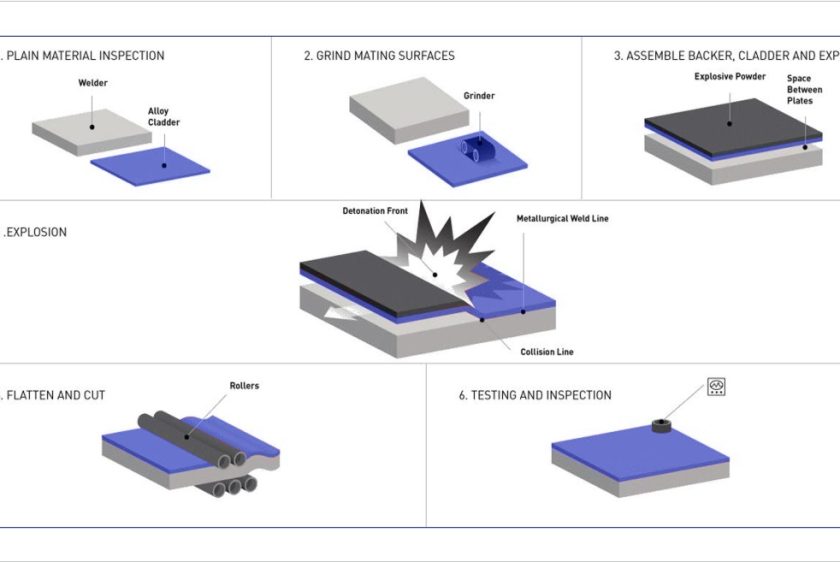
This becomes particularly valuable in chemical processing, petrochemical, fertilizer, chlor-alkali, refining, and other industries where corrosion can become a major lifecycle cost. Tinita’s application portfolio specifically identifies clad pressure vessels, reactors, heat exchangers, columns, and other equipment for demanding industrial environments.
A successful cladding solution, however, is not simply about joining two plates. Material compatibility, bond quality, forming, welding, heat input, inspection, machining, dimensional control, and process conditions all need to be considered. The fabrication procedure must protect the properties of the corrosion-resistant layer throughout the manufacturing process.
Explosion Clad vs Weld Overlay Cladding
Although both technologies are used to provide a corrosion-resistant surface, explosion cladding and weld overlay cladding are not the same process.
Explosion cladding joins a separate corrosion-resistant plate to a base metal through controlled high-velocity impact. Weld overlay, on the other hand, deposits a corrosion-resistant alloy onto the surface of a component using a welding process.
The choice depends on equipment geometry, material combination, thickness, operating conditions, design requirements, production considerations, and the desired corrosion barrier. Roll cladding is another approach in which materials are bonded through controlled rolling, while weld overlay creates the cladding layer directly through welding. Tinita lists explosion cladding, roll cladding, and weld overlay among the clad-construction methods used for static process equipment.
| Feature | Explosion Clad | Weld Overlay | Roll Clad |
|---|---|---|---|
| Basic principle | High-velocity solid-state bonding | Welding alloy onto surface | Bonding through rolling |
| Construction | Separate clad plate bonded to base plate | Deposited alloy layer | Composite bonded plate |
| Typical application | Large plates, vessels, heat exchanger components | Local or large-area corrosion protection | Clad plate manufacturing |
| Material flexibility | Broad range of dissimilar metals | Depends on welding metallurgy | Depends on material compatibility |
| Key consideration | Bond quality and plate preparation | Welding procedure and dilution | Rolling conditions and bond integrity |
There is no universal winner. The right method is the one that matches the actual process and design requirements.
What Is Weld Overlay?
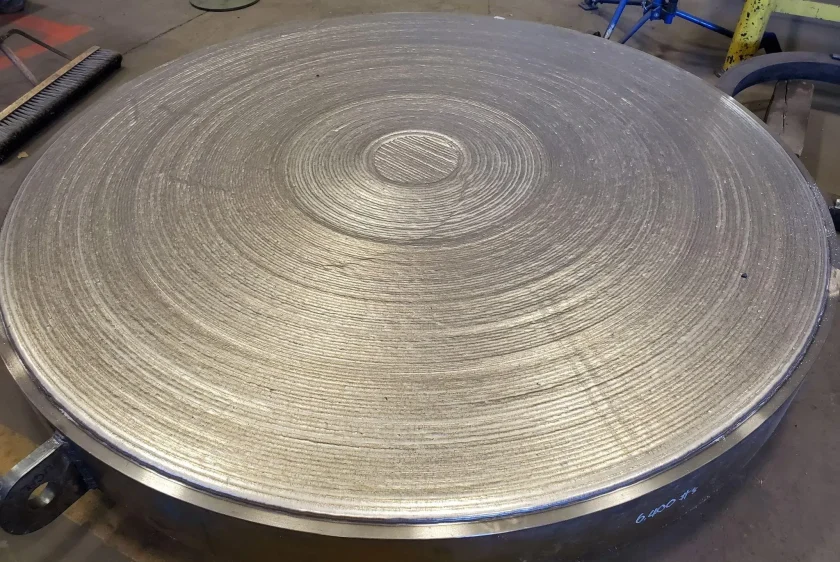
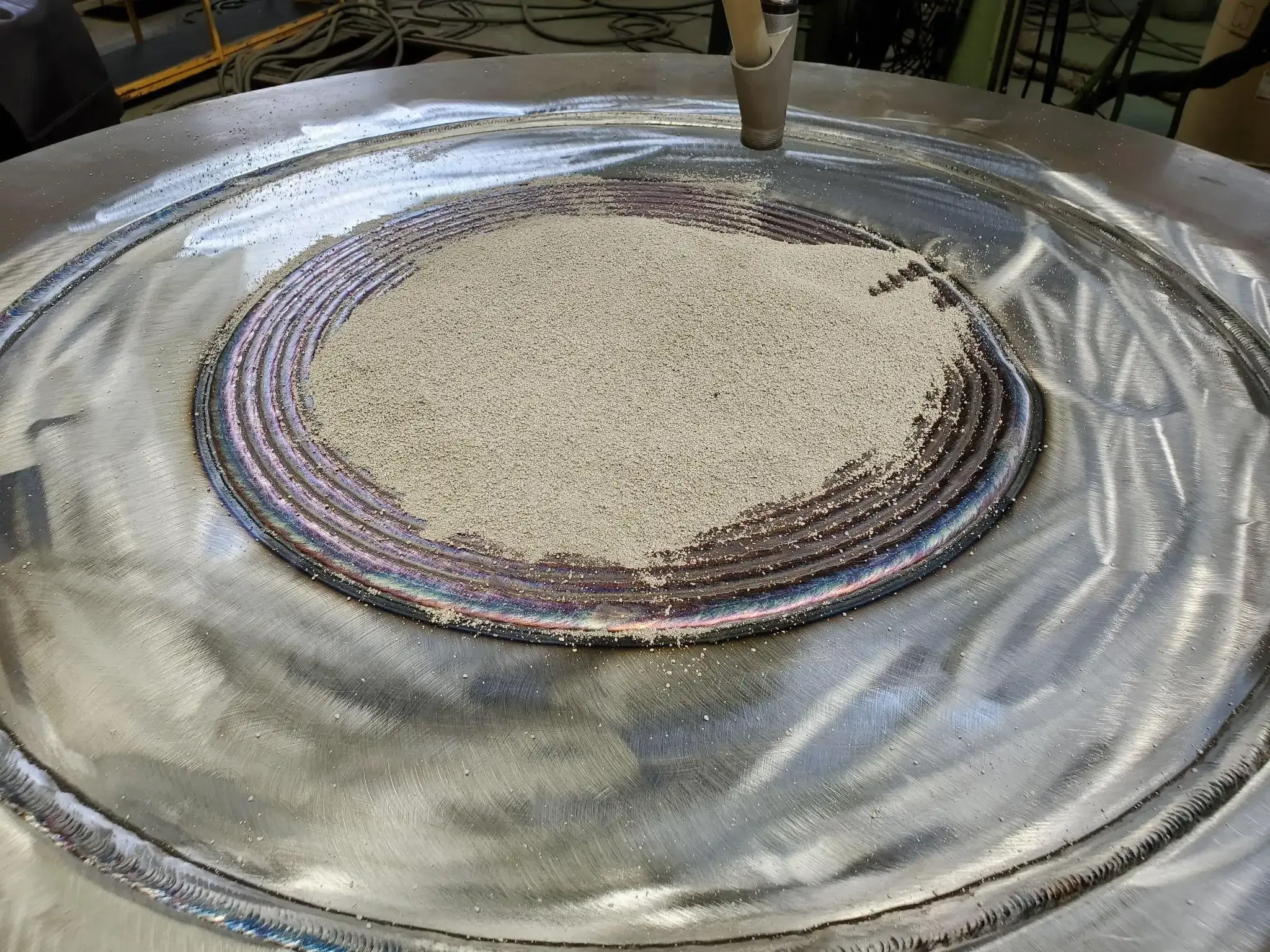
Weld overlay is a cladding technique in which a corrosion-resistant or wear-resistant alloy is deposited onto the surface of a base material using welding.
Instead of purchasing a completely solid component made from an expensive alloy, the equipment manufacturer can deposit the required alloy only where protection is needed. This can make weld overlay particularly useful for vessels, nozzles, piping components, pressure equipment, and areas where local corrosion resistance is important.
The deposited layer becomes the functional barrier between the process fluid and the underlying structural material. Depending on the application, processes such as GTAW, SMAW, SAW, or other qualified welding techniques may be selected.
The quality of a weld overlay cladding process depends heavily on the welding procedure. Factors such as heat input, travel speed, filler metal selection, dilution, number of layers, interpass temperature, surface preparation, and post-weld requirements must be carefully controlled.
Tinita Engineering highlights welding capabilities across exotic metallurgies including Titanium, Inconel, and Hastelloy, with SMAW, SAW, and GTAW processes forming part of its fabrication capabilities.
Weld Overlay Cladding Process: What Does It Involve?
A professional weld overlay process starts well before the welding arc is switched on. The engineering team first needs to understand the process conditions and determine which alloy provides the required resistance to the actual service environment.
Surface preparation is critical because contamination can affect weld quality and the integrity of the overlay. The base material and filler material must be verified against the approved material specifications, and the welding procedure needs to establish appropriate parameters for the selected metallurgy.
During deposition, the welder builds the corrosion-resistant layer over the specified surface. Multiple passes may be necessary to achieve the required thickness and chemistry. One of the key considerations is dilution, because excessive mixing between the base material and deposited alloy can alter the composition of the overlay.
Inspection and testing are equally important. Depending on the project specification, inspection may include visual examination, dimensional checks, non-destructive testing, chemical verification, hardness testing, or other applicable quality-control measures.
For critical pressure equipment, material selection, fabrication, welding and inspection should be aligned with the applicable design and manufacturing requirements, including relevant ASME codes and standards.
The objective is not simply to produce a visually attractive weld. The overlay must deliver consistent coverage and the metallurgical properties required for the intended service.
Inconel Overlay and Inconel 625 Weld Overlay
Among nickel-based materials, Inconel 625 weld overlay is an important option for applications requiring high corrosion resistance and mechanical performance.
Inconel 625 is a nickel-chromium-molybdenum-niobium alloy known for its resistance to a broad range of severe corrosive environments. Tinita’s nickel-alloy information identifies Inconel 625 as a high-performance alloy suitable for demanding environments and notes its strong corrosion resistance without requiring heat treatment for its basic alloy performance.
When engineers specify an Inconel 625 overlay, the objective is generally to provide a corrosion-resistant surface while maintaining a suitable structural base material underneath. This can be useful when the process side needs nickel-alloy protection but manufacturing the entire component from Inconel 625 would not be economically attractive.
An Inconel overlay welding procedure must account for the characteristics of the alloy and the base material. Welding parameters, filler selection, dilution control, interpass temperature, surface preparation, and inspection requirements should be established through an appropriate qualified procedure.
Welding procedure development and qualification are important when depositing corrosion-resistant alloys, particularly for demanding weld overlay applications. Technical resources from organizations such as TWI provide additional information on welding and joining technologies.
For critical equipment, the phrase “just weld Inconel on it” oversimplifies the engineering challenge. The real work lies in ensuring that the deposited layer has the required chemistry, thickness, bonding, geometry, and integrity after fabrication.
Titanium Fabrication for Corrosion-Resistant Equipment
Titanium is one of the most important exotic metals used for corrosion-resistant industrial equipment. Its combination of corrosion resistance, strength-to-weight ratio, and suitability for specific aggressive environments makes it valuable in chemical processing, chlor-alkali, seawater, power, and other applications.
Titanium Grade 2 is frequently selected for equipment exposed to demanding corrosion conditions. Fabricating Titanium, however, requires strict control over contamination and welding conditions. Titanium can react with atmospheric gases at elevated temperatures, making shielding and cleanliness particularly important during welding.
Tinita Engineering’s portfolio includes Titanium equipment such as reactors, heat exchangers, tanks, columns, and piping. Its website also documents Titanium Grade 2 cladded equipment and Titanium piping applications.
For engineers, the important point is that Titanium fabrication is not simply stainless-steel fabrication with a different filler wire. The material requires specialized handling, preparation, welding practices, and quality controls.
Tantalum Fabrication for Severe Corrosion
Tantalum is another highly corrosion-resistant exotic metal used in specialized chemical-process applications. It is particularly valuable where conventional materials and many corrosion-resistant alloys may not provide the required resistance.
Tantalum equipment can be found in demanding acid-service applications, including specialized heat-transfer equipment. Tinita’s recent website content includes Tantalum bayonet heaters for nitric acid and sulfuric acid applications, as well as Tantalum heat exchangers for acid pickling service.
Because Tantalum is a premium material, engineers generally use it strategically rather than unnecessarily. The fabrication approach must preserve the material’s corrosion-resistant properties while ensuring that the finished equipment satisfies dimensional, mechanical, and process requirements.
This is one reason why exotic metal fabrication requires more than basic manufacturing capacity. It requires metallurgical understanding.
Zirconium Fabrication for Aggressive Chemical Service
Zirconium is valued for its corrosion resistance in specific chemical environments and is used in specialized static process equipment where conventional materials may struggle.
Zirconium heat exchangers, reactors, columns, and other components can be engineered for demanding chemical applications. Tinita specifically lists Zirconium among its core exotic-metal materials and has documented Zirconium heat exchanger applications for sulfuric-acid service.
As with Titanium, fabrication quality depends heavily on contamination control, welding practice, material handling, and inspection. When Zirconium is used in critical static process equipment, the fabrication environment and procedure must be planned around the metallurgy rather than treating the alloy as an ordinary fabrication material.
Nickel Alloys, Inconel, Monel and Hastelloy
The term Nickel Alloys covers a broad family of materials developed for demanding corrosion and high-temperature environments. Within this category, alloys such as Inconel, Monel, Hastelloy, and other nickel-based materials can provide different combinations of corrosion resistance, strength, and temperature performance.
Tinita Engineering’s material range includes Nickel and Nickel Alloys, Inconel, Monel, and Hastelloy grades. Its published applications include nickel-alloy columns, heat exchangers, pressure vessels, reactors, and storage tanks for industries such as oil & gas, petrochemical, fertilizers, chemicals, pulp & paper, and power & energy.
Material selection should always be based on the actual process conditions. Two applications may both be described as “corrosive,” yet require completely different metallurgies because of differences in acid concentration, temperature, chlorides, oxidizing conditions, pressure, contaminants, or process chemistry.
That is why clad welding, overlay welding, and solid-alloy construction should be considered as engineering solutions rather than simply fabrication options.
Duplex & Super Duplex Stainless Steel Fabrication
Duplex and Super Duplex Stainless Steels combine characteristics of austenitic and ferritic stainless-steel structures, making them valuable for applications where high strength and strong corrosion resistance are required.
Super Duplex is particularly useful in demanding environments where resistance to localized corrosion is important. It can be found in equipment and systems exposed to chloride-containing environments and other aggressive service conditions.
Tinita’s published project information includes the supply of Super Duplex heat exchangers for petrochemical applications, with individual equipment weights reaching significant industrial scale.
The fabrication of Duplex and Super Duplex requires appropriate control of welding parameters and heat input because the final properties depend on maintaining a suitable metallurgical balance. Welding procedure qualification, consumable selection, heat control, and inspection therefore become important parts of the manufacturing process.
Clad Metals: Combining Strength and Corrosion Resistance
Clad Metals provide a practical solution when one material offers structural strength while another provides superior corrosion resistance.
A common concept is to use carbon steel as the structural base and a corrosion-resistant alloy as the process-contact surface. Depending on the application, the corrosion-resistant layer may be Titanium, Zirconium, Nickel Alloy, or another suitable material.
Tinita Engineering specifically describes clad construction as a composite design in which a corrosion-resistant alloy is bonded to a lower-cost structural material. Its capabilities include explosion bonding, roll cladding, and weld overlay.
This approach can be particularly attractive for pressure vessels, reactors, columns, and heat exchangers where the internal surface faces corrosive media but the entire pressure boundary does not need to be manufactured from the premium alloy.
The engineering advantage is straightforward: put the expensive metallurgy where it is needed most.
Choosing Between Explosion Clad and Weld Overlay
The choice between explosion clad and weld overlay depends on the equipment design rather than on which technology sounds more advanced.
Explosion cladding can be highly suitable for composite plates and applications where a separate corrosion-resistant plate needs to be bonded to a structural base. Weld overlay can be advantageous when a corrosion-resistant layer needs to be deposited directly onto a fabricated component or a selected area.
Geometry also matters. A large flat plate, cylindrical shell, nozzle, tube sheet, or complex internal surface may each present different fabrication challenges.
| Requirement | Potentially Suitable Approach |
|---|---|
| Large composite plates | Explosion cladding |
| Corrosion-resistant surface deposited after fabrication | Weld overlay |
| Large pressure vessels using composite construction | Explosion clad / clad plate |
| Local corrosion protection | Weld overlay |
| Specific dissimilar-metal plate combinations | Explosion bonding |
| Customized corrosion-resistant surfaces | Weld overlay |
The final decision should consider design code requirements, operating conditions, material availability, fabrication sequence, inspection requirements, and lifecycle economics.
Why Metallurgy Matters in Exotic Metal Fabrication
A successful exotic-metal project begins with metallurgy.
The same fabrication procedure cannot simply be applied to Titanium, Tantalum, Zirconium, Inconel, Duplex, and Super Duplex. Each material behaves differently during forming, welding, heat exposure, machining, and finishing.
Material selection should also consider the applicable material specification, testing requirements and project standards, with ASTM International standards commonly referenced for metallic materials and testing.
For example, Titanium demands stringent protection against atmospheric contamination during welding. Nickel alloys require careful consideration of welding behavior and corrosion performance. Duplex stainless steels require control of thermal cycles to maintain appropriate metallurgical balance. Clad construction introduces another layer of complexity because the interface between the base metal and corrosion-resistant layer becomes a critical part of the equipment.
This is why Tinita positions its capabilities around exotic metal fabrication and metallurgical expertise, rather than treating exotic alloys as an ordinary extension of carbon-steel fabrication. The company’s published capabilities include multiple exotic materials and welding processes, supported by specialized manufacturing infrastructure.
Exotic Metal Fabrication at Tinita Engineering
Tinita Engineering Pvt. Ltd. specializes in custom-engineered static process equipment fabricated from corrosion-resistant and high-performance materials. The company’s portfolio includes heat exchangers, reactors, pressure vessels, columns, storage tanks, piping spools, and customized equipment.
The company’s exotic metallurgy range includes:
- Titanium
- Tantalum
- Zirconium
- Nickel Alloys
- Inconel
- Monel
- Hastelloy
- Duplex & Super Duplex Stainless Steel
- Clad Metals
- High-grade stainless steels and specialized grades
Tinita also highlights welding capabilities for exotic metallurgies such as Titanium, Inconel, and Hastelloy using processes including SMAW, SAW, and GTAW. Its facilities include an ISO Grade 8 cleanroom for controlled manufacturing environments.
The company’s experience spans industries including oil & gas, petrochemical, fertilizers, chemical and specialty chemicals, pulp & paper, and power & energy.
Applications of Explosion Clad and Weld Overlay Equipment
The applications for clad and overlay construction are broad because corrosion is rarely limited to one industry. Chemical plants may require corrosion-resistant reactors and vessels, while petrochemical facilities may need clad columns, heat exchangers, and pressure equipment.
In chlor-alkali and chemical processing, Titanium, Nickel Alloys, Zirconium, and clad construction can be selected according to the specific process environment. In petrochemical applications, clad pressure vessels and columns can combine a structural base with a corrosion-resistant process surface.
Tinita’s published project and product information includes cladded reactors, clad columns, explosive-clad heat exchanger components, and static process equipment using Titanium, Nickel Alloys, Duplex, and other advanced materials.
The practical goal remains the same: provide equipment that can withstand the intended service environment while balancing fabrication complexity, reliability, and lifecycle value.
How to Select the Right Cladding Solution
Selecting a cladding overlay or corrosion-resistant material should begin with the process, not the material catalogue.
Engineers should evaluate the chemical composition of the process fluid, operating temperature, pressure, concentration, velocity, contaminants, chloride exposure, erosion potential, cleaning conditions, and expected equipment life. These parameters help determine whether solid alloy construction, explosion cladding, roll cladding, or weld overlay cladding is appropriate.
The equipment geometry also matters. A pressure vessel shell, tube sheet, nozzle, reactor internals, column, and piping spool may require different construction strategies.
Cost should also be evaluated over the complete equipment lifecycle. A cheaper material that requires frequent repair or replacement may become more expensive than a premium corrosion-resistant solution. Conversely, using an expensive exotic alloy where a suitable clad construction would work can unnecessarily increase the project cost.
The best solution is therefore not always the most expensive alloy. It is the material and fabrication strategy that provides the required performance for the actual process conditions.
Why Choose Tinita Engineering for Exotic Metal Fabrication?
Exotic-metal equipment demands a combination of engineering understanding, metallurgy, welding expertise, fabrication capability, quality control, and project execution.
Tinita Engineering has developed its capabilities around these requirements, with a materials portfolio covering Titanium, Tantalum, Zirconium, Nickel Alloys, Duplex & Super Duplex, and Clad Metals. The company manufactures static process equipment including heat exchangers, reactors, pressure vessels, columns, storage tanks, and piping systems.
Its published project history includes Titanium Grade 2 cladded reactor fabrication, Super Duplex heat exchangers, Zirconium equipment, Inconel equipment, and other specialized process systems.
For projects involving explosion clad, weld overlay, Inconel overlay, Titanium fabrication, Zirconium fabrication, Tantalum equipment, Nickel Alloy equipment, or Duplex and Super Duplex construction, the most important step is to discuss the process conditions and design requirements with an experienced fabricator before finalizing the metallurgy.
Final Thoughts
Explosion clad and weld overlay cladding have become important technologies for industries that need corrosion resistance without necessarily manufacturing an entire component from an expensive exotic alloy. Explosion bonding can create a strong metallurgical bond between dissimilar plates, while weld overlay deposits a corrosion-resistant alloy directly onto a prepared surface.
The real value, however, comes from selecting the right metallurgy for the application. Titanium, Tantalum, Zirconium, Nickel Alloys, Duplex & Super Duplex Stainless Steels, and Clad Metals each have different characteristics, fabrication requirements, and application advantages.
At Tinita Engineering Pvt. Ltd., these materials form an important part of the company’s exotic-metal fabrication capabilities. From Titanium and Zirconium equipment to Tantalum heat exchangers, Nickel Alloy process equipment, Super Duplex heat exchangers, explosion-clad construction, and weld overlay applications, the focus is on developing equipment around the actual process requirements rather than using a one-material-fits-all approach.
For industries handling corrosive chemicals, high temperatures, demanding pressure conditions, or aggressive process media, the right combination of metallurgy + cladding technology + fabrication expertise can make a significant difference to equipment reliability and service life.
Frequently Asked Questions
1. What is explosion clad?
Explosion clad is a solid-state bonding process that joins two dissimilar metals using controlled explosive energy and high-velocity impact. It is commonly used to create composite plates where a corrosion-resistant alloy is bonded to a structural base material.
2. What is the difference between explosion clad and weld overlay?
Explosion cladding bonds a separate metal plate to the base material, whereas weld overlay deposits a corrosion-resistant alloy onto the surface through welding. The appropriate method depends on the equipment design, metallurgy, service conditions, and project requirements.
3. What is Inconel 625 weld overlay used for?
Inconel 625 weld overlay can be used where a surface requires high resistance to demanding corrosive environments while the underlying component can be manufactured from a different structural material. The exact suitability depends on the process chemistry, temperature, pressure, and design requirements.
4. Which exotic metals does Tinita Engineering fabricate?
Tinita Engineering’s materials range includes Titanium, Tantalum, Zirconium, Nickel Alloys, Inconel, Monel, Hastelloy, Duplex & Super Duplex Stainless Steel, and Clad Metals.
5. What industries use clad and exotic-metal static process equipment?
Clad and exotic-metal equipment is used across oil & gas, petrochemical, fertilizer, chemical and specialty chemical, pulp & paper, power & energy, and other demanding industrial applications.



 English