
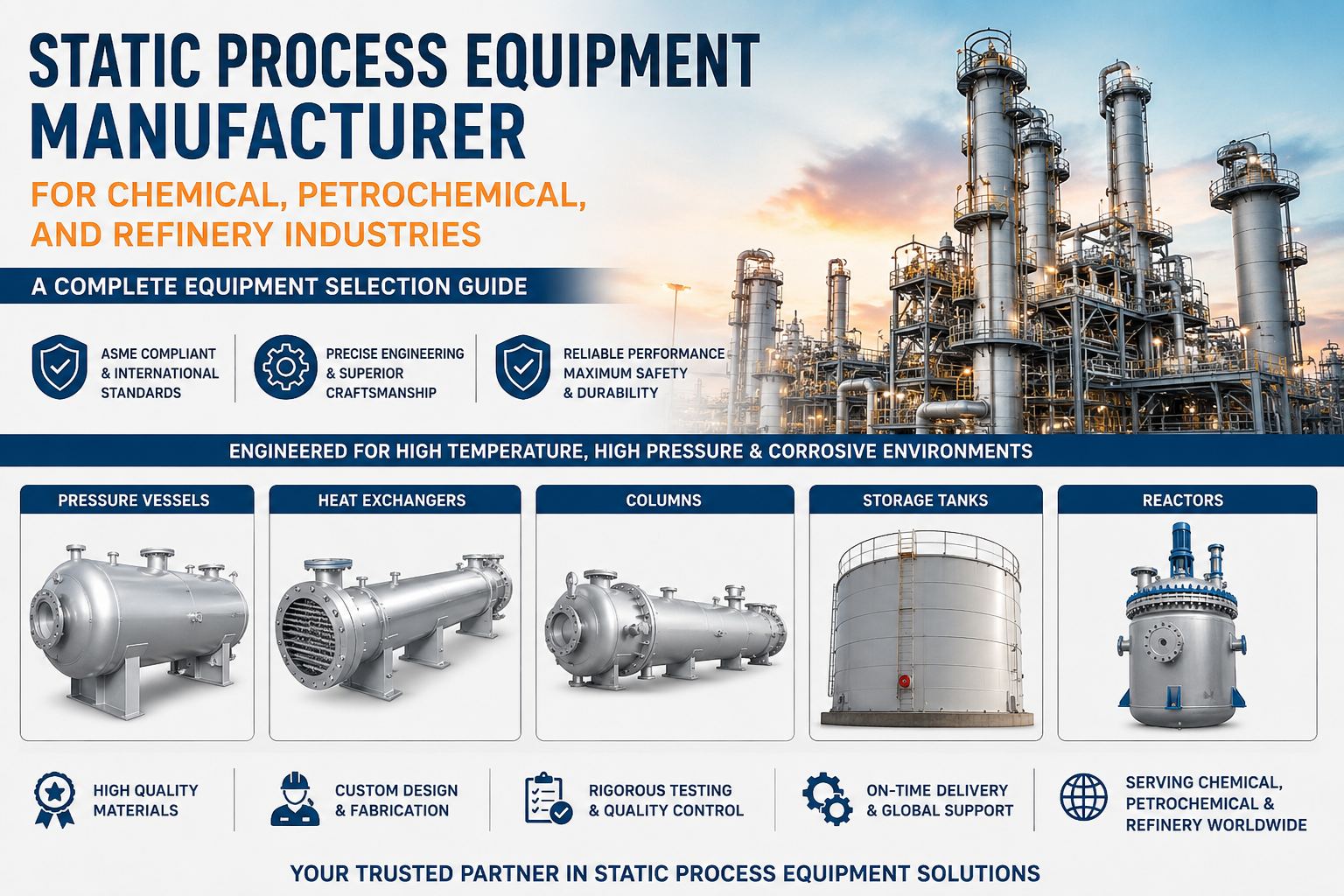
Chemical and refinery plants run at high temperatures. They handle corrosive fluids daily. Buying static equipment requires serious consideration. A reliable Process Equipment Manufacturer understands the exact mechanical specifications. A wrong supplier choice causes plant downtime and unplanned leaks, which cost money. This guide addresses ASME-compliant process equipment for chemical plants, emphasizing appropriate material selection and robust engineering practices to minimize operational risks, prevent leaks, and enhance overall plant safety.
Understanding Static Process Equipment Fundamentals for Buyers and Engineers
What Is Static Process Equipment?
Static process equipment has no moving parts, distinguishing it from rotating machinery such as pumps. Typical units include vessels and heat exchangers that contain fluids at high pressure and in corrosive conditions. Therefore, materials must withstand both pressure and chemical attack. Selecting a capable Process Equipment Manufacturer helps prevent leaks, protect plant personnel and reduce costly downtime caused by equipment failure.
The Role of a Process Equipment Manufacturer
A reliable Process Equipment Manufacturer ensures engineering accuracy. They perform the thermal calculations on their computers and carry out the mechanical design within their own facility. Verify their certificates. They need ASME and PED approvals. A manufacturer must control the whole process.
Industries Served and Equipment Demand Drivers
Chemical Plants and Agrochemical Facilities
Specialty chemical plants mix aggressive liquids daily. Bulk chemical facilities process large volumes of corrosive media. Both need heavy metal vessels. The equipment handles the toxic fluids continuously without leaking.
Petrochemical Plants and Polymer Production
Olefins and aromatics plants run hot after continuous service. The structures go through heavy thermal cycles constantly. The metal must not crack from the heat. Polymer production needs thick vessel walls.
Refineries and Crude Distillation Units
Crude distillation units operate at high pressure. Hydrotreating units process flammable hydrocarbons every day. The equipment works continuously for months. Refineries require exact engineering to prevent massive plant failures.
Pharmaceuticals and Fertilizer Plants
Fertilizer plants deal with extreme pressures and harsh chemicals. Pharmaceutical plants need clean metal surfaces. The internal finish must be perfect. Rough metal holds bacteria and ruins the product.
Types of Static Process Equipment and Selection Criteria
Different plant processes require different units. Buyers need to match the specific process conditions with the exact equipment type. Here is a look at them.
Heat Exchangers
A Heat Exchanger Manufacturer builds units that move heat between fluids. Buyers must check the heat duty. You look at fluid compatibility and fouling factors. The pressure ratings must match the process conditions. Refineries and chemical plants use them constantly to cool products.
Pressure Vessels
A Pressure Vessel Manufacturer builds heavy steel tanks. These include primary storage vessels and separators. The vendor follows ASME Section VIII. Buyer must specify the design pressure. You calculate the corrosion allowance. The manufacturer has to include proper inspection access ports.
Reactors
Chemical reactions occur in such units. A Reactor Manufacturer builds fixed-bed or jacketed types. An engineer looks at the specific process chemistry. Exothermic reactions produce a lot of heat. Residence time matters. The vessel needs pressure relief systems for safety.
Distillation Columns
Plants use these large vertical units to separate liquid mixtures. A Distillation Column Manufacturer builds tray columns and packed columns. You specify the internal packing. The engineer checks the separation efficiency. Vapor-liquid equilibrium directly determines the required column height.
Material Selection for Corrosion-Resistant Process Equipment
Carbon steel rusts fast in chemical plants. Standard alloys fail under acid attacks. You must use specific metals to handle aggressive fluids and stop leaks.
Titanium Equipment
Plants install Titanium Equipment for severe corrosive environments. The metal handles chlorides well. It resists seawater and oxidizing acids. Chlor-alkali plants and desalination facilities use it heavily. Fabrication is very difficult. Welding titanium needs a clean environment. The long service life covers the price.
Zirconium Equipment
We use Zirconium Equipment in extreme chemical conditions. The metal survives direct contact with hydrochloric acid. It handles sulfuric acid easily. Acetic acid plants require it. Forming the metal takes specific skill. The welding process is strict. Quality assurance takes time during heavy manufacturing.
Hastelloy Equipment
Hastelloy Equipment handles strong mixed acids. Grades like C276 survive reducing and oxidizing environments. Refineries use them in hydrodesulfurization units. Petrochemical plants install them in scrubbers. Standard nickel alloys corrode fast in these processes. Hastelloy lasts longer. The fabricator needs deep experience in welding it.
Why Choose Tinita Engineering?
Tinita Engineering operates as a Process Equipment Manufacturer. The company builds static equipment from metals like titanium and zirconium. They hold ASME certificates. The engineering team does the thermal and mechanical design in-house. Plant operators facing aggressive corrosion rely on their integrated manufacturing capabilities to prevent leaks and maintain steady production schedules.



 English