
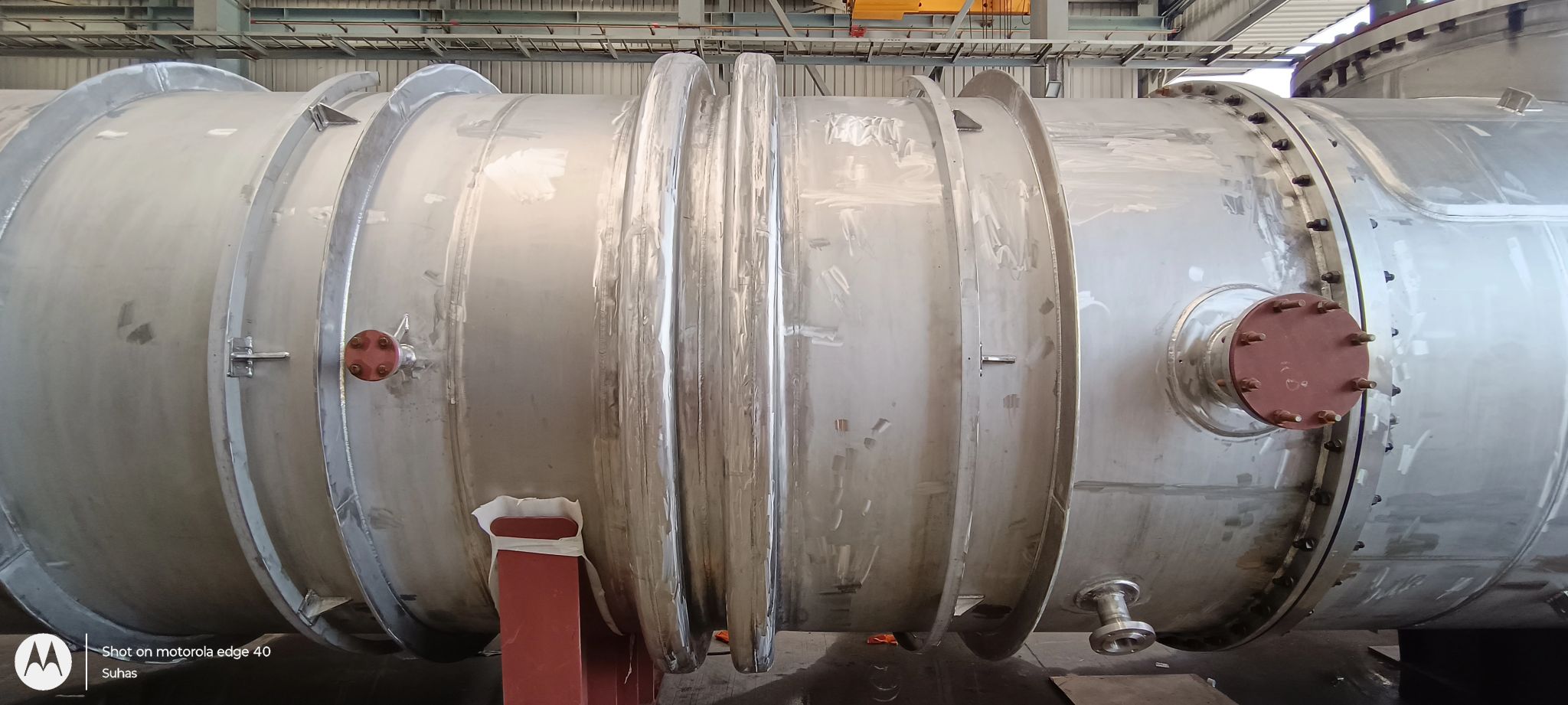
What Is an Expansion Joint in a Heat Exchanger?
An expansion joint in heat exchanger is a flexible component designed to accommodate movement caused by thermal expansion and contraction. When a heat exchanger operates, its shell, tubes, tube sheets and other components may experience different temperature changes. Because different materials and components can expand at different rates, the resulting movement can create stresses that need to be considered during mechanical design. An expansion joint or bellows arrangement can provide controlled flexibility where the exchanger configuration requires it.
This is particularly relevant to shell and tube heat exchangers, where two fluids can operate at significantly different temperatures. One fluid may be hot while the other is relatively cold, creating a temperature difference between the shell and tube-side components. If the exchanger is not designed to accommodate the resulting movement, excessive thermal stress can affect components, welds, connections or other parts of the equipment. The Tubular Exchanger Manufacturers Association (TEMA) includes an expansion joint among the recognized components of shell-and-tube heat exchangers and provides mechanical-design guidance for these exchangers.
The important point is that an expansion joint is not simply an accessory added to every exchanger. Its requirement depends on the exchanger configuration, operating conditions, temperature differential, materials, dimensions and mechanical design. That is why expansion management should be considered during the engineering stage rather than treated as an afterthought during fabrication.
Why Are Expansion Joints Used in Heat Exchangers?
A heat exchanger is designed to transfer heat, but that same heat transfer creates a mechanical challenge: thermal movement. Imagine heating a long metal component from room temperature to several hundred degrees Celsius. It does not remain exactly the same size. It expands. When it cools, it contracts again. In a large industrial heat exchanger, these dimensional changes can become significant enough to influence the mechanical design.
An expansion joint in a heat exchanger provides a controlled way to accommodate this movement when required. The objective is to prevent thermal expansion from creating excessive stresses in the shell, tubes, tube sheet, welds or connected piping. This becomes especially important when the shell and tube bundle experience different temperatures or when the exchanger is constructed from materials with different thermal expansion characteristics.
The need for an expansion joint in heat exchanger generally arises when different components experience significant differential thermal expansion.
The need for thermal-expansion management is recognized in professional exchanger design. TEMA’s current standards include design provisions related to heat exchanger mechanical design, while its specification sheet explicitly identifies expansion joint as an equipment-design item.
Managing Thermal Expansion
Thermal expansion is one of the fundamental reasons engineers consider expansion joints and bellows. A component that is free to expand can generally accommodate its dimensional change more easily than a component that is rigidly restrained. When movement is restricted, stresses can build up.
In a shell-and-tube heat exchanger, the shell and tubes may not experience the same temperature or expansion. A flexible design feature can help accommodate the resulting differential movement. However, the exact solution depends on the exchanger configuration. Some designs can accommodate thermal movement through their geometry or tube-sheet arrangement, while others may require a dedicated expansion joint.
Reducing Thermal Stress
The purpose is not simply to make the equipment “move.” The movement must be controlled within the limits established by the mechanical design.
An improperly designed expansion arrangement can create its own problems, including excessive movement, fatigue concerns, instability or leakage. Therefore, the bellows or expansion joint needs to be designed for the expected operating conditions and verified as part of the complete exchanger design.
For critical equipment, engineers should consider design temperature, pressure, cycles, differential expansion, materials, connected piping loads and applicable codes or standards before selecting an expansion arrangement.
What Is an Expansion Bellow in a Heat Exchanger?
An expansion bellow in heat exchanger is a flexible, corrugated metallic component that can absorb controlled axial movement and, depending on its design, other forms of movement. The corrugated shape allows the bellows to flex while maintaining the pressure boundary when properly engineered.
You can think of a bellows as a controlled “flexible zone” built into an otherwise rigid piece of equipment. Instead of forcing the entire exchanger shell or piping system to absorb thermal movement, the bellows can be designed to accommodate a defined amount of movement.
Bellows are commonly manufactured from metals selected according to pressure, temperature, corrosion conditions and fatigue requirements. The geometry, number of convolutions, thickness and material properties all influence how the bellows behaves during operation.
A good example of the principle can be seen in industrial tubular heat exchanger designs where a bellows is incorporated to absorb thermal expansion.
That does not mean every heat exchanger needs a bellows. The decision must come from the mechanical and thermal design of the specific equipment.
When engineers evaluate an expansion joint in heat exchanger design, they need to consider thermal movement, operating temperature, pressure, materials and the expected number of thermal cycles.
Types of Expansion Joint in Heat Exchanger
The phrase types of expansion joint in heat exchanger can refer to different arrangements used to accommodate thermal movement. The appropriate design depends on the exchanger construction, movement requirements and service conditions.
In practice, engineers may use flexible bellows arrangements or select a heat exchanger configuration that naturally accommodates differential expansion. For example, floating-head and U-tube configurations can provide different approaches to managing thermal movement without relying on exactly the same expansion-joint arrangement.
TEMA’s standards recognize multiple shell-and-tube exchanger configurations and include expansion joints within the equipment nomenclature. The current TEMA standards also include guidance related to exchanger type selection, mechanical design, inspection, repairs and installation.
Bellows-Type Expansion Joints
A bellows-type expansion joint uses the flexibility of a corrugated metallic element to accommodate controlled movement. Depending on the application, the movement may be primarily axial, although specific bellows designs can accommodate other movement modes.
The bellows must be designed carefully because repeated thermal cycling can create fatigue stresses. The number of expected operating cycles therefore matters, especially in equipment that experiences frequent start-up and shutdown.
Material selection is equally important. A bellows operating in a corrosive chemical environment may require a corrosion-resistant alloy rather than conventional carbon steel. This is where the expertise of an exotic-metal fabricator becomes particularly valuable.
Fixed Tube Sheet and Expansion Management
A fixed tube sheet heat exchanger has a rigid tube-sheet arrangement that can make differential thermal expansion an important design consideration. Depending on the temperature difference and exchanger geometry, the design may require an expansion joint in the shell to accommodate differential movement.
This is one reason why thermal analysis and mechanical design cannot be separated from heat exchanger fabrication. The exchanger configuration needs to be evaluated as a complete system.
Other exchanger configurations, such as U-tube or floating-head designs, can provide different methods of accommodating thermal expansion. The appropriate selection depends on the process and mechanical requirements rather than simply choosing the most common configuration.
Expansion Joint in Shell and Tube Heat Exchanger
The expansion joint in a shell and tube heat exchanger is particularly important when there is a significant difference in thermal expansion between the shell and tube-side components.
A shell-and-tube exchanger typically contains a shell, tube bundle, tube sheets, channels, baffles, nozzles and other components. One process fluid flows through the tubes while another flows around the tube bundle inside the shell. This arrangement is widely used for heating, cooling, condensing and other process duties.
Now consider what happens when the shell is exposed to one temperature while the tubes operate at another. The two sets of components may attempt to expand by different amounts. If their movement is heavily restrained, mechanical stresses can develop.
An expansion joint in a shell and tube heat exchanger can help accommodate differential movement between the shell and tube-side components when required by the mechanical design.
An expansion joint can be incorporated into the shell when the design requires additional flexibility. Its job is to accommodate the calculated differential movement without compromising the pressure boundary.
TEMA’s current specification sheet specifically includes Expansion Joint as a design item for shell-and-tube heat exchangers, reinforcing the fact that expansion management is part of the mechanical design process rather than merely a fabrication detail.
Why Are Expansion Bellows Used in Heat Exchangers?
The primary reason expansion bellows are used in heat exchangers is to accommodate controlled thermal movement. When temperature changes cause components to expand or contract, the bellows provides flexibility that can reduce restraint-related stresses.
But there is more to it than simply “absorbing expansion.” The bellows must operate within its design movement, pressure, temperature and fatigue limits. Its geometry and material need to be selected based on the expected service conditions.
This becomes especially important in process industries where heat exchangers may experience repeated thermal cycles. Frequent startup and shutdown, changing process conditions and cleaning operations can increase the number of thermal cycles experienced by the equipment.
The correct design therefore considers both the amount of movement and the number of cycles expected over the equipment’s service life. This is one reason why bellows design should be handled by engineers with appropriate mechanical and fabrication expertise.
A flexible component can solve a thermal-expansion problem, but only when it is properly integrated into the overall equipment design.
Materials Used for Heat Exchanger Expansion Joints
Material selection is an important consideration when specifying an expansion joint in heat exchanger. The selected material needs to withstand the operating temperature, pressure, process chemistry and repeated thermal movement expected during service. Depending on the application, engineers may consider stainless steels, Titanium, Tantalum, Zirconium, Nickel Alloys, Duplex & Super Duplex, or Clad Metals. For highly corrosive process environments, the expansion component may require a specialized alloy or corrosion-resistant construction rather than a conventional material.
Material selection is a critical part of designing an expansion joint in heat exchanger. The material must withstand the expected temperature, pressure, corrosion environment and cyclic loading.
For standard applications, stainless steels and other conventional engineering alloys may be suitable. For aggressive chemical environments, however, more specialized materials may be required.
This is particularly relevant for Tinita Engineering because its fabrication capabilities include a broad range of exotic metals and corrosion-resistant materials.
Titanium
Titanium offers excellent corrosion resistance in many demanding environments and is widely used in specialized process equipment. Titanium Grade 2 is an important industrial grade for corrosion-resistant applications.
When Titanium is used in an expansion component, fabrication must account for its welding and contamination-control requirements.
Tantalum
Tantalum is known for exceptional corrosion resistance in selected chemical environments. It can be used strategically in highly demanding process applications where conventional alloys may not provide sufficient resistance.
Because it is a premium material, Tantalum is generally used where its specific performance justifies its application.
Zirconium
Zirconium provides excellent corrosion resistance in several aggressive chemical environments and is used in specialized process equipment.
For an expansion component or heat exchanger manufactured from Zirconium, fabrication and welding practices must be developed around the material’s metallurgical characteristics.
Nickel Alloys
Nickel Alloys, including materials such as Inconel, Monel and Hastelloy, can offer combinations of corrosion resistance, strength and high-temperature performance.
The correct grade depends on the process chemistry and operating conditions. There is no single “best” nickel alloy for every application.
Duplex & Super Duplex
Duplex and Super Duplex Stainless Steels combine high strength with strong corrosion resistance and are used in demanding industrial environments.
Their fabrication requires appropriate control of welding parameters and thermal cycles to maintain the required metallurgical properties.
Clad Metals
Clad Metals provide another approach to combining structural strength with corrosion resistance. A corrosion-resistant alloy can be bonded or deposited over a structural base material, allowing the premium metallurgy to be used where it is needed.
For demanding heat exchanger applications, cladding can be achieved through technologies such as explosion bonding, roll cladding or weld overlay, depending on the equipment design and specification.
Design and Fabrication Considerations
Designing an expansion joint or bellows is not simply a matter of selecting a corrugated component from a catalogue. The engineering team needs to understand the complete operating envelope of the heat exchanger.
Important considerations include:
- Design and operating temperature
- Design and operating pressure
- Differential thermal expansion
- Expected thermal cycles
- Bellows movement
- Corrosion conditions
- Material compatibility
- Fatigue requirements
- Connected piping loads
- Welding and fabrication requirements
- Inspection and testing
- Applicable design codes and project specifications
The TEMA Standards are an important industry reference for shell-and-tube heat exchanger mechanical design. TEMA states that its standards have achieved worldwide acceptance as an authority for shell-and-tube heat exchanger mechanical design, and its 11th Edition includes updated guidance on exchanger selection, inspection, repairs, installation and other areas.
Fabrication quality is just as important as design. The bellows, shell, tube sheets and other components must be manufactured according to the approved drawings, procedures and applicable quality requirements.
For exotic materials, additional attention may be required for material identification, cleanliness, welding procedure qualification, heat input, shielding, inspection and surface protection.
Applications of Heat Exchanger Expansion Joints
Heat exchanger expansion joints can be relevant across industries where thermal gradients and differential expansion need to be controlled.
These include:
- Oil & gas
- Petrochemical
- Fertilizer
- Chemical processing
- Specialty chemicals
- Power generation
- Pulp & paper
- Pharmaceutical processing
- Refining
- Energy and industrial utilities
Shell-and-tube heat exchangers themselves are used for a broad range of heating and cooling duties involving liquids and gases.
In demanding chemical and petrochemical applications, material selection becomes especially important. A heat exchanger may require Titanium, Nickel Alloys, Duplex, Super Duplex or clad construction depending on the process environment.
This demonstrates an important engineering principle: thermal management and metallurgy often need to be considered together.
Expansion Joints and Exotic Metal Fabrication
When a heat exchanger operates in a corrosive environment, the expansion component cannot be evaluated separately from the rest of the equipment. The material used for the bellows or expansion joint must be compatible with the process environment and the surrounding materials.
This is where exotic metal fabrication becomes important.
Tinita Engineering works with a range of high-performance metallurgies, including Titanium, Tantalum, Zirconium, Nickel Alloys, Duplex & Super Duplex Stainless Steels, and Clad Metals. These materials are used for specialized process equipment where corrosion resistance, mechanical performance and service life are critical.
A heat exchanger may require an exotic alloy for the tubes, tube sheets, shell-side surfaces, expansion components or corrosion-resistant cladding. The exact construction depends on the process conditions and engineering specification.
The benefit of working with a fabricator experienced in multiple metallurgies is that the equipment can be considered as a complete engineered system rather than as a collection of unrelated components.
How to Select the Right Expansion Joint
There is no universal expansion joint that works for every heat exchanger. The right solution starts with understanding the equipment’s operating conditions and mechanical configuration.
First, determine the expected temperature difference and calculate the associated thermal movement. Then consider the exchanger type, shell and tube materials, pressure, operating cycles and connected piping. From there, engineers can determine whether an expansion joint is required and what type of flexible arrangement is appropriate.
Material selection should follow the process conditions. A component exposed to aggressive chemicals may need a corrosion-resistant alloy, while a less severe application may allow a conventional material.
The fabrication method should also be considered early. For specialized materials, forming, welding, inspection and testing requirements can influence the final design.
A well-designed expansion joint should not be viewed as an isolated component. It is part of the heat exchanger’s overall mechanical integrity strategy.
Why Choose Tinita Engineering for Heat Exchangers?
Tinita Engineering Pvt. Ltd. specializes in the fabrication of process equipment and heat exchangers for demanding industrial applications. Its capabilities include shell-and-tube heat exchangers, reactors, columns, pressure vessels, piping spools and other engineered equipment.
One of Tinita’s key strengths is its experience with exotic and corrosion-resistant metallurgies. The company’s material capabilities include Titanium, Tantalum, Zirconium, Nickel Alloys, Duplex & Super Duplex Stainless Steels, and Clad Metals.
This broad metallurgy capability is particularly valuable when a heat exchanger has challenging process conditions. Instead of treating material selection and fabrication as separate activities, the project can be developed around the required combination of thermal performance, mechanical strength, corrosion resistance and fabrication feasibility.
Tinita also highlights specialized welding capabilities for exotic materials and manufacturing infrastructure for critical process equipment. For customers requiring customized heat exchangers, the important consideration is not simply whether a manufacturer can fabricate a shell-and-tube exchanger, but whether it understands the metallurgy and fabrication requirements behind the specified equipment.
When selecting an expansion joint in heat exchanger, the engineering team should evaluate the complete operating envelope rather than considering thermal movement alone. Shell and tube configuration, differential temperature, pressure, materials, thermal cycles, corrosion conditions and connected piping loads can all influence the final design. A properly engineered expansion solution should accommodate the required movement while maintaining the mechanical integrity of the heat exchanger throughout its service life.
For technically demanding applications, that distinction matters.
Final Thoughts
An expansion joint in heat exchanger plays an important role when the equipment needs to accommodate differential thermal expansion. As temperatures change, the shell, tubes and other components can experience dimensional changes. If those movements are excessively restrained, thermal stresses can develop and affect the long-term reliability of the equipment.
Expansion bellows in heat exchangers provide a controlled flexible element that can accommodate specified movement when incorporated into an appropriate design. However, the need for an expansion joint and the selection of its configuration should always be determined through proper thermal and mechanical analysis.
For shell and tube heat exchangers, the decision can depend on exchanger configuration, temperature differences, materials, pressure, thermal cycles and applicable design requirements. TEMA’s current standards provide an established reference for shell-and-tube heat exchanger mechanical design and specifically recognize expansion joints within exchanger design terminology.
Material selection is equally important for demanding process applications. Titanium, Tantalum, Zirconium, Nickel Alloys, Duplex & Super Duplex, and Clad Metals can provide solutions for environments where conventional materials may not be sufficient.
At Tinita Engineering Pvt. Ltd., the combination of heat exchanger fabrication and exotic-metal expertise enables customers to approach challenging process-equipment requirements with a broader range of material and fabrication options. Whether the requirement involves a conventional shell-and-tube heat exchanger or specialized corrosion-resistant equipment, the right design begins with understanding the process, the metallurgy and the mechanical requirements together.
Frequently Asked Questions
1. What is an expansion joint in a heat exchanger?
An expansion joint in a heat exchanger is a flexible component used to accommodate controlled thermal movement. It can help manage differential expansion between components such as the shell and tube bundle when required by the mechanical design.
2. What is an expansion bellow in a heat exchanger?
An expansion bellow in a heat exchanger is a corrugated flexible metallic component designed to accommodate specified thermal movement. Its design depends on factors such as pressure, temperature, movement, material and expected operating cycles.
3. Why are expansion bellows used in heat exchangers?
Expansion bellows are used when a heat exchanger requires a flexible element to accommodate thermal expansion or contraction. They can help reduce excessive restraint and associated thermal stresses when properly designed and integrated into the equipment.
4. Does every shell and tube heat exchanger require an expansion joint?
No. The requirement depends on the exchanger configuration, temperature difference, materials, dimensions, thermal movement and mechanical design. Some configurations can accommodate differential expansion through their inherent design, while others may require a dedicated expansion joint.
5. What materials can be used for heat exchanger expansion components?
Material selection depends on the operating environment. Depending on the application, engineers may consider stainless steels, Titanium, Tantalum, Zirconium, Nickel Alloys, Duplex & Super Duplex, or Clad Metals. The final selection should be based on temperature, pressure, corrosion conditions, cyclic loading and applicable specifications.
6. What factors determine the selection of an expansion joint in a heat exchanger?
The selection of an expansion joint in heat exchanger depends on operating temperature, pressure, differential thermal expansion, exchanger configuration, materials, expected thermal cycles, corrosion conditions and applicable design requirements.



 English