
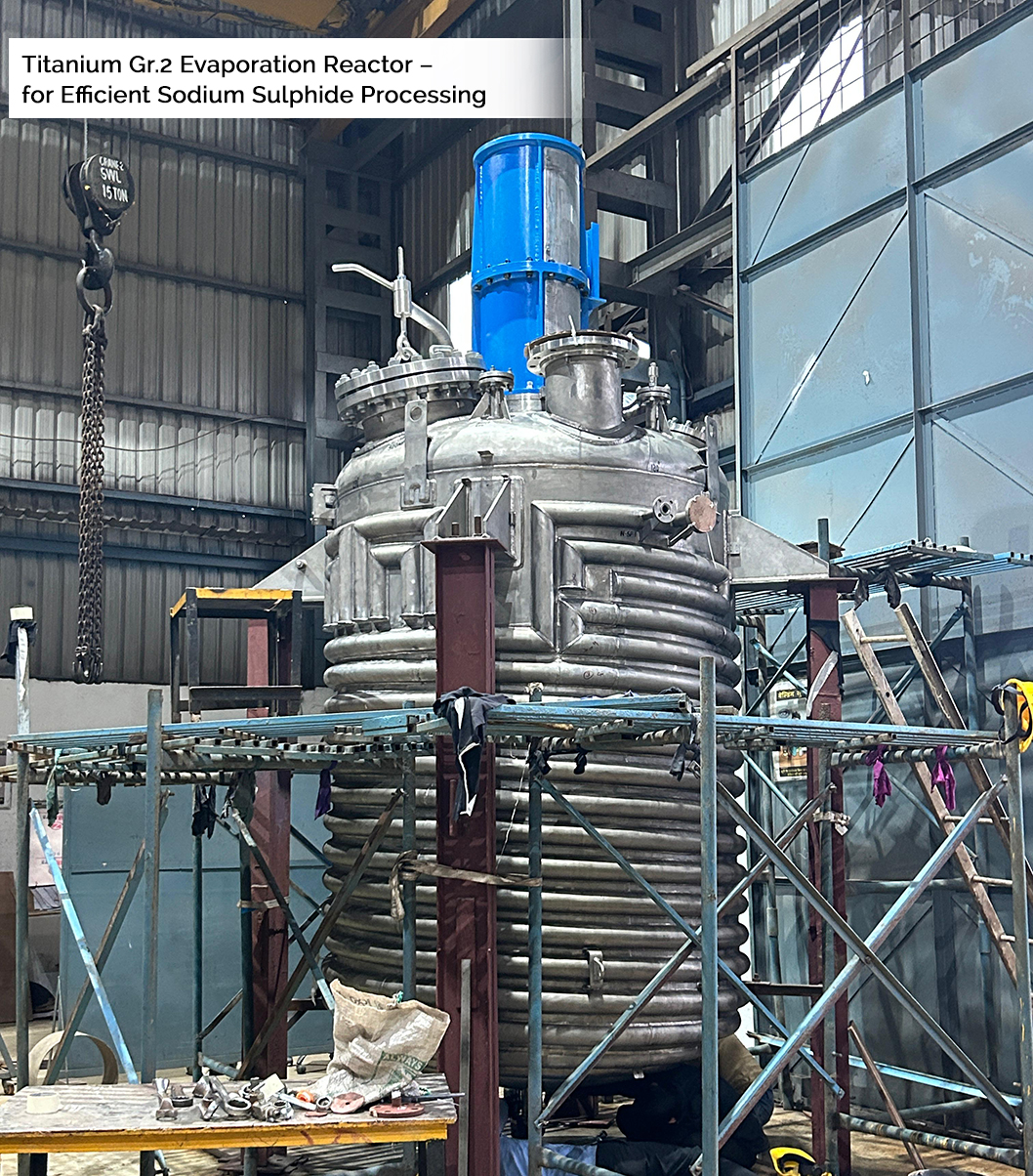
Sodium sulphide processing requires equipment that can withstand demanding chemical conditions, elevated temperatures, and concentrated process streams. Choosing the right material for the reactor is therefore an important part of maintaining reliability, product quality, and plant efficiency.
A titanium reactor can be an effective solution for applications where corrosion resistance and long-term service performance are critical. Titanium Grade 2 is particularly valued for its corrosion resistance, relatively low density, good mechanical properties, and suitability for chemical process equipment.
At Tinita Engineering, we manufacture titanium process reactors and specialised static process equipment for demanding industrial applications. Our fabrication capabilities include commercially pure titanium and other exotic metals used in chemical processing, petrochemical, power, and related industries.
What Is a Titanium Reactor?
A titanium reactor is a process vessel manufactured using titanium to carry out chemical reactions, mixing, heating, concentration, or other controlled process operations.
Titanium is selected for reactor construction primarily because of its excellent corrosion resistance in many aggressive chemical environments. Depending on the process conditions, Titanium Grade 2 can provide a useful combination of corrosion resistance, strength, formability, and fabrication characteristics.
A typical titanium reactor may incorporate:
- Titanium shell and heads
- Process nozzles and connections
- Heating or cooling arrangements
- Agitator or mixing systems, where requiredHeating surface design Heat-transfer requirements
- Manways and inspection openings
- Internal components
- External support structures
- Specialised linings or clad construction, depending on the application
The final design depends on the process fluid, operating temperature and pressure, corrosion conditions, vessel dimensions, and applicable design standards.
Titanium Grade 2 Reactor for Chemical Processing
A titanium Gr 2 reactor is manufactured using commercially pure Titanium Grade 2. The material specification and applicable requirements should be verified against the relevant ASTM specification for commercially pure titanium. It is one of the commonly used titanium grades for chemical processing equipment because of its combination of corrosion resistance and mechanical properties.
Titanium Grade 2 develops a stable passive oxide film on its surface. This passive layer provides significant protection against corrosion in many environments and is one of the primary reasons titanium is used for chemical process equipment.
However, titanium is not universally corrosion-proof. Its performance depends on the complete process chemistry, including temperature, concentration, pH, impurities, oxidising or reducing conditions, and the presence of other chemical species.
For this reason, material selection for a titanium reactor should be based on the actual process conditions rather than material grade alone.
Why Titanium Is Considered for Sodium Sulphide Processing
Sodium sulphide processing can expose equipment to chemically demanding conditions, particularly when temperature and concentration increase during evaporation or concentration operations.
In such applications, selecting an appropriate material can help reduce corrosion-related maintenance and improve equipment service life.
A sodium sulphide reactor or process vessel may require careful consideration of:
- Sodium sulphide concentration
- Operating and design temperature
- Operating and design pressure
- Process pH
- Water content
- Impurities and contaminants
- Heating medium
- Corrosion allowance and material compatibility
- Welding and fabrication requirements
Where process conditions are compatible with titanium, Titanium Grade 2 can offer an attractive alternative to conventional materials for specific components or complete process equipment.
Proper material selection is an important part of corrosion management, particularly when equipment is exposed to aggressive chemical environments. Guidance from organisations such as AMPP can support broader corrosion-management practices.
Titanium Evaporation Reactor for Concentration Processes
A titanium evaporation reactor is designed for processes where heating and evaporation are required to remove a volatile component, commonly water, and concentrate the remaining process solution.
In sodium sulphide processing, evaporation can increase the concentration of the process stream and therefore places additional demands on equipment materials and heat-transfer surfaces.
The design of a titanium evaporation reactor may involve:
- Heating surface design
- Heat-transfer requirements
- Residence time
- Process circulation
- Operating temperature
- Vacuum or pressure conditions
- Evaporation rate
- Scaling and deposition considerations
- Drainability and cleanability
The equipment geometry and heat-transfer arrangement should be selected according to the actual process requirements. A well-designed system can help maintain consistent operation while reducing unwanted deposition and maintenance requirements.
Titanium Chemical Reactor: Key Advantages
A titanium chemical reactor can provide several advantages in applications where conventional materials may not provide the required corrosion resistance.
1. Excellent Corrosion Resistance
Titanium is known for its strong resistance to corrosion in many chemical environments. Its passive oxide layer provides protection against a wide range of corrosive media.
2. High Strength-to-Weight Ratio
Titanium combines useful mechanical strength with relatively low density. This can be advantageous when equipment weight is an important consideration.
3. Suitable for Demanding Chemical Applications
Titanium equipment is widely used in selected chemical processing applications where corrosion resistance is a major material-selection consideration.
4. Long Service Potential
When the titanium grade is correctly selected for the process environment and the equipment is properly designed and fabricated, titanium can provide long-term service with reduced corrosion-related maintenance.
5. Material Purity
For applications where material contamination must be controlled, titanium can provide a suitable process-contact material when correctly specified and fabricated.
Fabrication of a Titanium Process Reactor
Manufacturing a titanium process reactor requires more than simply forming and welding titanium components. Fabrication practices must be carefully controlled because titanium can react with atmospheric gases at elevated temperatures.
During welding, adequate shielding is essential to protect the molten weld pool and heated areas from atmospheric contamination.
Depending on the design conditions, a titanium reactor may also be engineered as a specialised pressure vessel subject to the applicable design code and inspection requirements.
Important fabrication considerations include:
- Controlled welding procedures
- Proper argon shielding
- Clean tools and work surfaces
- Prevention of iron and other metallic contamination
- Qualified welders and welding procedures
- Controlled handling and storage of titanium plates
- Dimensional inspection
- Non-destructive testing where specified
- Pressure and leak testing as applicable
For projects intended for the European market, applicable regulatory requirements should also be considered during the design and fabrication stage. Depending on the equipment category and operating conditions, the Pressure Equipment Directive (PED) may apply to pressure equipment placed on the European market. The specific compliance requirements should be established based on the project specifications, equipment classification, design conditions, and applicable regulations.
These controls help maintain the mechanical and corrosion-performance characteristics expected from the titanium material.
Corrosion-Resistant Reactor Titanium: What to Consider
The phrase corrosion resistant reactor titanium is often associated with applications where conventional stainless steels or other alloys may not provide adequate corrosion resistance.
However, no material should be selected solely on the basis of a general corrosion-resistance statement.
For a titanium reactor, engineers should evaluate the complete operating environment, including:
- Chemical composition
- Temperature
- Concentration
- Pressure
- Flow velocity
- Contaminants
- Oxidising or reducing conditions
- Expected operating cycles
- Cleaning chemicals
- Start-up and shutdown conditions
This process-based approach helps determine whether Titanium Grade 2 or another material is appropriate for the specific application.
Sodium Sulphide Evaporation Vessel Design Considerations
A sodium sulphide evaporation vessel must be designed around both the chemical environment and the evaporation process.
As the process solution becomes more concentrated, the operating conditions can change significantly. Heat-transfer surfaces, vessel internals, nozzles, welds, and other process-contact areas therefore require careful engineering consideration.
Depending on the application, the vessel may include:
- Heating jackets or coils
- Specialised heat-transfer surfaces
- Agitation or circulation arrangements
- Process nozzles
- Inspection manways
- Instrument connections
- Drain and vent connections
- Insulation and external cladding
- Suitable supports
The final configuration should be established from the process datasheet, P&ID, design conditions, material requirements, and applicable engineering standards.
Applications of Titanium Reactors
Titanium reactors are used in industries where corrosion resistance and process compatibility are important.Tinita Engineering manufactures industrial reactors for demanding process applications.
Chemical Processing
Titanium process equipment can be used for selected chemical reactions, concentration processes, heat-transfer applications, and corrosive process streams.
Pulp and Paper
Titanium is used in selected pulp and paper applications involving aggressive chemical environments, particularly where corrosion resistance is critical.
Petrochemical and Process Industries
Certain process applications require corrosion-resistant materials for reactors, vessels, heat exchangers, and other static equipment.
Specialty Chemicals
Specialty chemical manufacturers may use titanium equipment where process chemistry places high demands on material compatibility.
Waste Treatment and Recovery
Titanium can be considered for selected waste-treatment and recovery applications involving corrosive process streams, subject to detailed chemical compatibility assessment.
Titanium Reactor vs Conventional Materials
Material selection should always be based on the actual process conditions. Stainless steel, nickel alloys, duplex alloys, titanium, and other materials each have specific advantages and limitations.
Titanium may become particularly attractive when corrosion resistance, equipment service life, and process compatibility are more important than the initial material cost alone.
Depending on the process configuration, heat-transfer requirements may also involve shell and tube heat exchangers or other specialised heat-transfer equipment.
The objective is not simply to select the most corrosion-resistant material. It is to select the right material for the process conditions and expected equipment life.
Why Choose Tinita Engineering for Titanium Reactor Fabrication?
Tinita Engineering Pvt. Ltd. specialises in the fabrication of static process equipment and exotic metal equipment for demanding industrial applications.
Our manufacturing experience includes exotic metals such as titanium, tantalum, nickel alloys, Hastelloy, Monel, Inconel, zirconium and other specialised alloys.
- Titanium
- Tantalum
- Nickel alloys
- Hastelloy
- Monel
- Inconel
- Alloy 20
- Zirconium
- Duplex and Super Duplex stainless steels
- Alloy 904L
Our equipment portfolio includes reactors, pressure vessels, shell and tube heat exchangers, columns, and other engineered process equipment.
For titanium fabrication, controlled material handling and welding practices are important to maintain material integrity and prevent contamination during manufacturing.
Tinita Engineering supports projects from engineering and fabrication through inspection, testing, documentation, and delivery, depending on the project scope.
Get a Titanium Reactor Designed for Your Process
Selecting the right titanium reactor starts with understanding the process rather than simply choosing a material grade.
If your application involves sodium sulphide processing, evaporation, concentration, corrosive chemicals, or other demanding process conditions, our engineering team can evaluate the application and recommend a suitable equipment configuration.
For your next titanium chemical reactor, titanium evaporation reactor, or titanium process reactor, contact Tinita Engineering to discuss your process requirements, design conditions, material specifications, and fabrication requirements.
Contact Tinita Engineering to discuss your titanium reactor project.



 English