
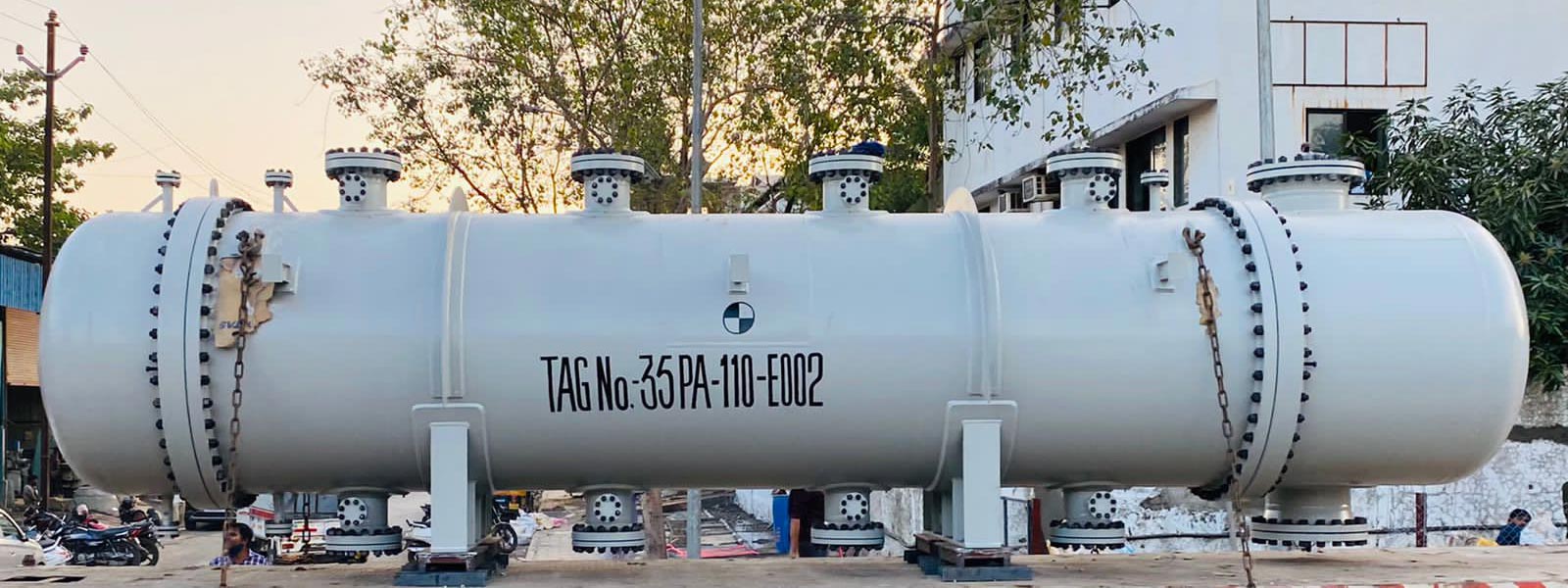
Heat exchangers are essential devices used across industries to transfer heat between two fluids without mixing them. They play a crucial role in power generation, chemical processing, HVAC systems, oil refineries, and more. Choosing the right industrial heat exchanger depends on factors such as temperature requirements, fluid properties, operating pressure, and space constraints.
Below, we explain the major types of heat exchangers, their working principles, design features, and industrial uses.
1. Shell & Tube Heat Exchanger
A shell and tube heat exchanger is one of the most widely used designs in the process industry due to its versatility and efficiency. It consists of a series of tubes placed inside a cylindrical shell. One fluid flows inside the tubes while the other flows around them within the shell.
Key Details:
- Design Flexibility: Supports single-pass or multi-pass configurations.
- Applications: Used in petrochemical plants, oil refineries, power plants, and marine applications.
- Advantages: Handles high-pressure operations, allows easy cleaning, and supports a wide range of temperature differences.
This heat exchanger design is ideal for large-scale industrial heat transfer needs.
2. Double Pipe Heat Exchanger
A double pipe heat exchanger is one of the simplest designs, consisting of one pipe inside another. The two fluids flow in opposite directions (counterflow) or the same direction (parallel flow).
Key Details:
- Cost-Effective: Low initial investment and maintenance.
- Best For: Small to medium-scale heat transfer requirements.
- Advantages: Compact size, high heat transfer efficiency in counterflow arrangement.
- Limitations: Not suitable for very large heat transfer rates.
It’s often used in food processing, small chemical plants, and research facilities.
3. Hairpin Heat Exchanger
A hairpin heat exchanger (also called a double-pipe hairpin exchanger) features a U-shaped configuration that allows long flow paths in a compact footprint.
Key Details:
- High Thermal Efficiency: Long length promotes better heat transfer.
- Applications: Ideal for industries with limited space but high-performance needs.
- Advantages: Easy disassembly for cleaning, can handle high temperatures and pressures.
- Industries: Oil & gas, power generation, and chemical processing.
4. Air-Cooled Heat Exchanger
An air-cooled heat exchanger uses ambient air to cool process fluids instead of water. Large fans blow air over finned tubes, carrying heat away.
Key Details:
- Water-Free Operation: Ideal for areas with limited water availability.
- Energy Efficiency: Reduces water treatment costs and environmental impact.
- Applications: Petrochemical plants, natural gas processing, power plants.
- Advantages: Lower operational costs, minimal maintenance, eco-friendly.
This design is widely used in remote and arid regions where water cooling is impractical.
5. Feedwater Heater
A feedwater heater is used in power plants to preheat boiler feedwater using extracted steam from the turbine.
Key Details:
- Efficiency Boost: Improves thermal efficiency of power generation.
- Types: Open feedwater heaters (direct contact) and closed feedwater heaters (surface type).
- Advantages: Reduces thermal shock to the boiler, saves fuel, and increases plant efficiency.
- Industries: Primarily used in steam power plants.
6. Evaporators
An evaporator heat exchanger removes heat from a liquid to change it into vapor, commonly used in refrigeration and desalination.
Key Details:
- Function: Utilizes a heat source to evaporate process fluid.
- Types: Falling film, forced circulation, and plate evaporators.
- Applications: Food & beverage processing, chemical manufacturing, seawater desalination.
- Advantages: High energy efficiency, precise temperature control.
Final Thoughts
Selecting the right heat exchanger requires careful evaluation of operational conditions, fluid properties, and maintenance requirements. A trusted manufacturer like Tinita Engineering Pvt. Ltd. provides high-quality solutions tailored to meet diverse industrial needs, ensuring performance, reliability, and longevity.


 English