
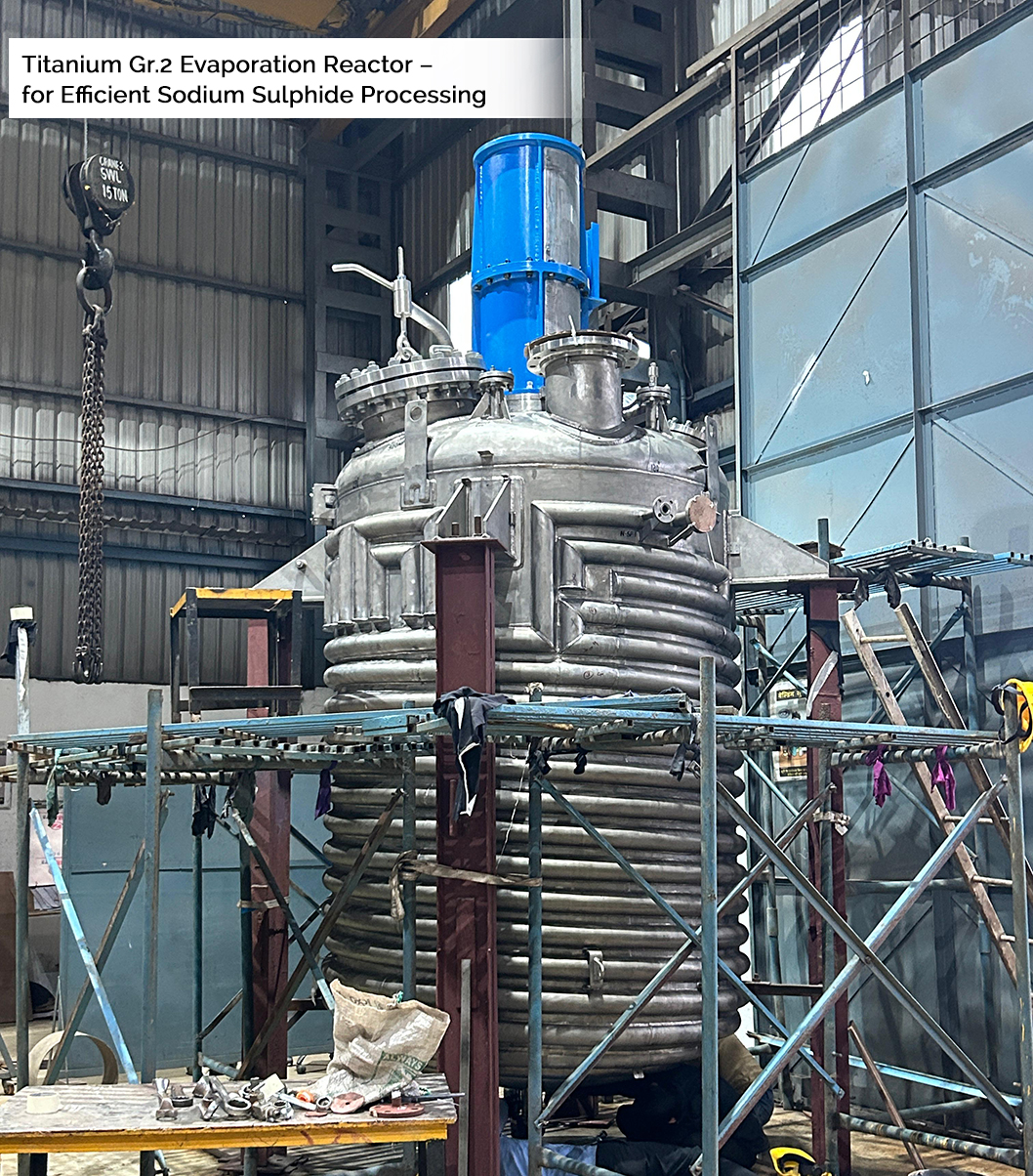
Processing sodium sulphide presents significant operational challenges due to its corrosive and reactive nature. The chemical environment is harsh and corrodes standard metals quickly. Most plants are moving away from basic steel because it fails too often. This has led to an increase in demand for the titanium grade 2 reactor. In the evaporation stage, the heat and chemical concentration reach their limit. You need a material that won’t crack or thin out under pressure. At Tinita, we specialise in fabricating these units to meet the strict needs of modern chemical plants. We focus on building a titanium process reactor that handles the most aggressive fluids without failing.
Titanium Gr 2 Reactor: Technical Overview for Industrial Manufacturers
A titanium gr 2 reactor is built from commercially pure titanium. It has a high strength-to-weight ratio and resists heat. Unlike stainless steel, it does not suffer from pitting in chloride or sulphide solutions. Fabrication requires a clean environment to avoid gas contamination during welding. We use argon shielding to keep the welds strong and ductile. Many buyers choose this over duplex alloys because it lasts decades instead of years. It is a preferred choice for long-term industrial use.
Why Material Choice Matters: The Titanium Gr 2 Reactor
Grade 2 titanium is the most important material in the chemical industry. It is unalloyed and offers an excellent combination of strength and formability. This “commercially pure” metal forms a tight oxide film on its surface. This film prevents corrosion before it starts. While the initial cost is higher than steel, you save money over time. The plant faces less downtime and fewer repairs. We source high-purity ingots to ensure no contaminants enter the metal. This purity is vital for a titanium gr 2 reactor to perform as expected in a live plant.
Engineering Excellence: The Titanium Evaporation Reactor
The titanium evaporation reactor manages the high-temperature concentration process essential to sodium sulphide manufacturing. The aim is to remove water and concentrate the product. Titanium has excellent thermal conductivity for a corrosion-resistant metal. This allows for fast heat transfer and shorter cycle times. We optimise the wall thickness to balance pressure ratings with heating efficiency. Our designs handle high-pressure steam and high-temperature cycles without warping. This makes the evaporation process safer and more predictable for operators.
Precision Fabrication of the Sodium Sulphide Reactor
Building a sodium sulphide reactor requires deep knowledge of the chemical’s behaviour. At high concentrations, sodium sulphide becomes even more aggressive. We design the vessel to prevent stress corrosion cracking in the heat-affected zones. Every joint is precision-machined before welding. We follow international standards like ASME and PED for all pressure vessels. We ensure the structural integrity of every flange and nozzle. This attention to detail prevents leaks that could shut down the entire line.
Durability Defined: The Corrosion-Resistant Reactor Titanium
When you compare a corrosion-resistant reactor titanium build to stainless steel, the difference is clear. Stainless steel forms a thin chrome layer that can easily strip away. Titanium has a “self-healing” oxide layer. If the surface gets scratched, the layer forms instantly in the presence of oxygen. This prevents deep pitting and crevice corrosion. In a harsh industrial setting, this reactor can easily outlast three steel vessels. It provides a stable environment for chemical reactions in the long run.
Maximising Yield with a Sodium Sulphide Evaporation Vessel
The shape of a sodium sulphide evaporation vessel is just as important as the material. We use specific vessel geometries to stop salt from accumulating on the walls. Scaling can ruin heat transfer and slow down the yield. We offer custom options like agitators and heating jackets to keep the fluid moving. Every sodium sulphide evaporation vessel we make undergoes non-destructive testing (NDT). We use X-rays and dye tests to check every weld. This ensures your custom fabrication project meets the highest quality marks.
Applications of Titanium Grade 2 Reactors in Various Industries
The titanium chemical reactor is a versatile tool used in many sectors beyond just sodium sulphide.
- Pulp and Paper Industry
Plants use these reactors to handle bleaching chemicals like chlorine dioxide. Titanium resists the acidic environment that destroys other metals. This keeps the production line running without frequent patch jobs.
- Chemical Manufacturing Plants
Refineries use these vessels for organic acid processing and salt brine evaporation. The metal stays stable even when temperatures spike. It ensures the purity of the final chemical product.
- Textile Processing
Dye houses work with caustic soda and various bleach solutions. A titanium chemical reactor handles these mixtures without contaminating the fabrics. It provides a clean, rust-free environment for sensitive dyes.
- Waste Treatment and Recovery Systems
Facilities use titanium to recover precious metals or neutralise toxic runoff. The reactors handle mixed waste streams that would degrade plastic or coated steel. It is the safest way to manage hazardous fluids.
Why Manufacturers Choose Tinita for a Titanium Chemical Reactor
Choosing us at Tinita means choosing a partner who knows everything about titanium. We don’t just weld metal; we engineer solutions for the toughest jobs. Our team understands the risks of interstitial contamination. We maintain a dedicated shop space for titanium to maintain purity. We provide full documentation for every titanium chemical reactor we ship. You get a vessel that is ready for heavy service on day one. Contact us today to discuss your next project and get a quote.


 English